

A bull case is not an instruction to buy. It is an argument to audit.
The best bullish research makes a company legible: what is changing, why this business might benefit, what the market may be missing, and which numbers would confirm the idea. The worst version turns a rising chart into destiny, treats a total addressable market as revenue, and saves risk for one polite paragraph at the end.
The reader’s job is not to become bearish. It is to separate evidence from possibility before enthusiasm becomes position size.
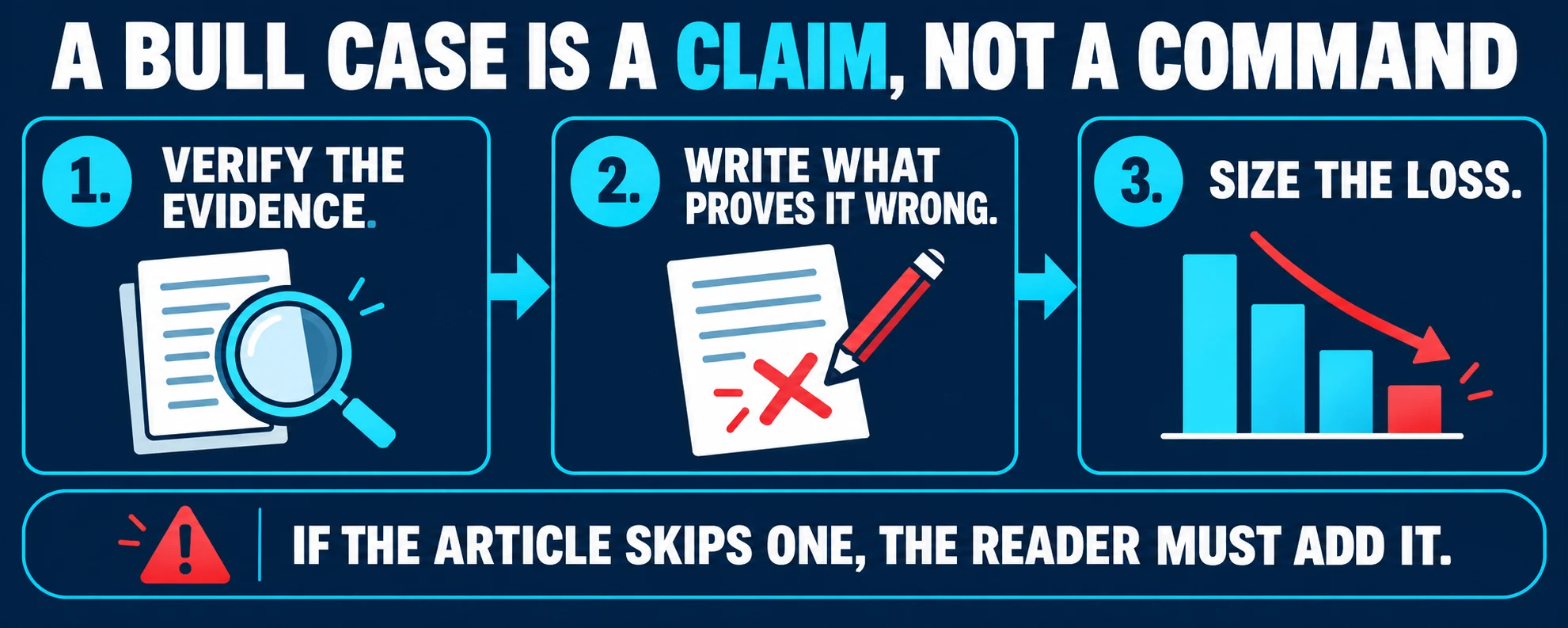
I use three passes: evidence, falsification, and size. To show how the process works, I will walk through our existing Kratos bull case. The point is not to add a new ticker. It is to turn one company article into a reusable reading method.
Reader note: This article provides general educational and informational content, not individualized financial, investment, tax, legal, or trading advice. A research framework cannot remove market risk, prevent loss, or determine an appropriate position for you.
The One-Sentence Thesis
Read every bull case as three separate decisions: whether the evidence is real, what would prove the thesis wrong, and how much loss the portfolio can absorb.
Here is the framework in one screen:
| Pass | Core question | Red flag |
|---|---|---|
| Evidence | What has happened already? | Pipeline, capacity, and contract ceilings presented as revenue |
| Falsification | What observable result breaks the idea? | Risks are vague, external, or impossible to measure |
| Size | What happens if this falls 50%? | Conviction substitutes for drawdown math |
Pass One: Convert the Story Into Evidence
Start by marking every important statement as one of four types:
- Fact: reported revenue, funded backlog, cash, debt, units delivered.
- Management target: guidance, capacity plan, margin objective, production goal.
- Opportunity: pipeline, total addressable market, IDIQ ceiling, potential order.
- Interpretation: the author’s conclusion about what those facts may mean.
These categories are not equally strong.
In the Kratos article, second-quarter revenue, funded backlog, cash, and share count came from company filings. Those are historical receipts. Management’s goal to produce roughly 40 Valkyries annually by the start of 2028 is a target. The approximately $15 billion bid-and-proposal pipeline is an opportunity. The claim that Kratos is a picks-and-shovels bet on affordable mass is an interpretation.
None is useless. The mistake is letting the largest number win without asking what kind of number it is.
A contract ceiling is not funded revenue. Factory capacity is not customer demand. A successful demonstration is not repeat production. Backlog is stronger, but it can include unfunded work and may still be modified. Cash collected after delivery is stronger again.
This is why primary sources matter. The SEC says 10-Ks contain audited annual statements and risk factors, 10-Qs provide quarterly financial updates, and 8-Ks disclose material events. Use the article to find the claim; use filings to test it. SEC EDGAR guide
Pass Two: Demand a Falsification Test
A thesis that cannot be proven wrong is a story with permanent immunity.
Good falsification tests are observable and time-bound. “The market does not understand the company” is not one. “Funded orders fail to replace deliveries for four quarters while capacity spending continues” is closer.
For the Kratos case, the article identifies several tests:
- Valkyrie work must become funded quantities, accepted deliveries, and repeat production.
- New propulsion and hypersonic programs must convert from development and options into task orders and production revenue.
- Book-to-bill should not remain below 1.0 while factories expand.
- Margins should scale as production rises.
- Free cash flow should improve after the investment cycle.
- Per-share economics must outgrow dilution.
Notice what is not on the list: “the stock fell 20%.” Price may contain information, but price alone does not identify which operating claim failed.
The opposite mistake is also common. A company announces a new contract and the bull declares victory. The right question is: funded for how much, recognized when, at what margin, with what working capital, and divided across how many shares?
One headline rarely closes that chain.
Pass Three: Size the Consequence, Not the Excitement
Even a well-sourced bull case can be wrong. Position size is where intellectual uncertainty becomes financial survival.
Suppose the reader decides the evidence is credible and the falsification tests are fair. The next question is not “How high can it go?” It is “What does a plausible failure do to my liquid net worth?”
If a 4% position falls 50%, the portfolio-level damage is about 2%. If a 30% position falls 50%, the damage is 15%. Same article. Same company. Radically different outcome.
FINRA describes concentration risk as amplified losses from having a large portion of holdings in one investment, asset class, or segment. It also warns that overlapping funds can hide repeated exposure to the same company or sector. FINRA
Our full guide to position sizing starts with maximum acceptable portfolio damage. That is the right sequel to any bull case.
The Bull-Case Audit Sheet
Before acting on a bullish article, answer these questions in writing.
Evidence
- What are the three strongest historical receipts?
- Which numbers come from filings rather than presentations or headlines?
- Which claims are guidance, targets, capacity, pipeline, or total market?
- Is growth organic, acquired, or funded by dilution?
- Is the author using per-share results or only company-level growth?
Falsification
- What must happen in the next four quarters?
- What result would make the thesis weaker even if the stock rises?
- What competitor, customer, regulatory, or financing event changes the economics?
- Which metric cannot keep being explained away?
- When is the next honest review date?
Valuation
- What growth and margin path does today’s price already require?
- Could the business execute while the multiple compresses?
- What return is available from less risky alternatives?
- Am I confusing thesis risk with valuation risk? Our two-checklist framework separates them.
Size
- What percentage of liquid net worth is exposed directly and through funds?
- What would a 30%, 50%, or 70% decline cost in dollars?
- Would that loss force a sale or change a life goal?
- What weight triggers a trim or review?
If the article does not answer these questions, that does not automatically make it bad. It means the research is unfinished for your decision.
Warning Signs in Any Bull Case
I slow down when I see these patterns:
- The largest number is a total market, contract ceiling, or pipeline.
- Every risk is macro, temporary, or someone else’s fault.
- Management’s adjusted metric is treated as cash.
- Acquisitions drive growth but dilution and debt are ignored.
- The valuation section uses next year’s best case and today’s balance sheet.
- A price decline is presented as proof of cheapness.
- The author specifies upside but never defines invalidation.
- The conclusion creates urgency without a new piece of evidence.
The goal is not cynicism. It is calibration. A bull case should leave you more capable of saying no.
The Bottom Line
The useful output of a bull case is not excitement. It is a testable statement.
For Kratos, the test is not whether autonomous defense remains a compelling theme. It is whether demonstrations and capacity become funded production, higher margins, free cash flow, and per-share value. That chain can be monitored. If it fails, the thesis weakens. If it succeeds, valuation and position size still matter.
Read the evidence. Write the break condition. Size the loss. Then decide.
That is how a bull case becomes a process instead of a bag.
This article is educational and informational only. It is not a recommendation to buy, sell, short, or hold Kratos Defense or any other security, and it does not provide individualized financial, investment, tax, legal, or trading advice. Investing can result in loss of principal. Company filings, market prices, contracts, and conditions can change; verify the latest information before making a decision.