

A stock can be 30% too expensive and still become a five-year winner.
It can also be a wonderful company and a terrible one-year investment. Those statements are not contradictory. They describe two clocks: the business compounds on one, while the market’s willingness to pay for that business moves on another.
Investors get into trouble when they merge the clocks. If the price falls, they assume the thesis broke. If the company posts another strong quarter, they assume the stock must go up. Neither conclusion follows automatically.
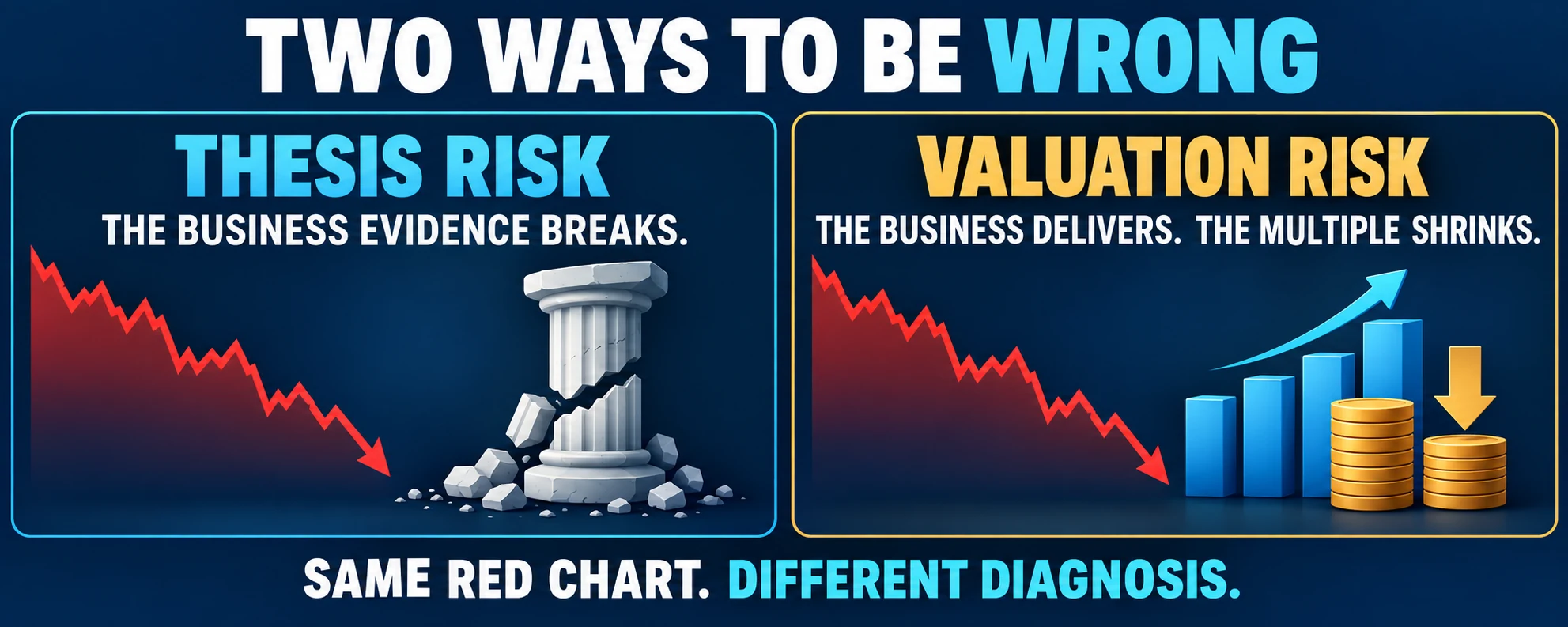
Valuation risk is not thesis risk. The first asks what happens if the market pays less for the same stream of earnings. The second asks whether the stream of earnings is still likely to exist.
Reader note: This article provides general educational and informational content, not individualized financial, investment, tax, legal, or trading advice. Valuation is uncertain, and a low or falling price does not by itself make a security attractive.
The One-Sentence Thesis
A good investment process separates what the business must do from what the market must pay, because operating progress can coexist with a falling stock.
Here is the distinction in one screen:
| Question | Thesis risk | Valuation risk |
|---|---|---|
| What changed? | Revenue quality, margins, moat, balance sheet, execution | Discount rate, sentiment, comparable multiples, starting price |
| Where is the evidence? | Filings, unit economics, customers, cash flow | Price, market cap, enterprise value, earnings yield |
| Can the company execute and the stock fall? | Yes | Yes—this is the core case |
| Typical response | Re-underwrite or exit if evidence breaks | Lower expected return, smaller size, longer horizon, or wait |
| Common mistake | Calling every decline “noise” | Calling every expensive stock a bad company |
One Company, Two Variables
At its simplest, a stock price reflects some combination of the company’s financial output and the multiple investors attach to it.
Imagine a company earns $5 per share and trades at 30 times earnings. The stock is $150. Five years later, earnings have doubled to $10 per share. That is real business progress. But if the market now pays 20 times earnings, the stock is $200—not $300.
The business doubled earnings. The stock gained about 33% before dividends. Multiple compression absorbed most of the operating growth.
Now take the same business at a 15 times starting multiple. If earnings double and the ending multiple is still 20, the stock moves from $75 to $200. Same company. Same earnings. Very different return because the entry price changed.
These are simplified illustrations, not forecasts. They omit dilution, debt, cash, taxes, dividends, and changes in the quality of earnings. They make one point: you can be right about the business and wrong about the price paid. Investor.gov defines the price-to-earnings ratio as stock price divided by earnings per share and notes that it can help gauge whether a price is high or low relative to history or other companies. It is a comparison tool, not an oracle. Investor.gov
Checklist One: Did the Thesis Break?
I would treat these as business questions, not chart questions.
Demand
- Is the customer problem still urgent?
- Are bookings, usage, units, or retention confirming the story?
- Is growth organic, or mostly purchased through acquisitions?
Economics
- Are gross margins and contribution margins moving as expected?
- Is revenue turning into operating cash flow?
- Is stock-based compensation or dilution consuming the per-share gain?
Advantage
- Is the product still differentiated?
- Are switching costs, distribution, regulation, scale, or data reinforcing the moat?
- Has a competitor changed the price-performance equation?
Balance sheet
- Can the company fund the plan without a distressed raise?
- Are debt maturities, covenants, or working-capital needs becoming the real thesis?
Management execution
- Did management hit the milestones that justified the original underwriting?
- Are misses temporary and explained, or recurring and renamed?
The SEC’s EDGAR guide points investors to 10-Ks for audited statements and risk factors, 10-Qs for quarterly updates, and 8-Ks for material events. That is where a thesis should be tested. A social-media thread may identify a question; the filing should help answer it. SEC EDGAR guide
If the answers deteriorate together, the thesis may be breaking. A lower stock price is then an effect, not the evidence.
Checklist Two: Did the Multiple Compress?
These questions belong to the price side.
- Did Treasury yields rise, increasing the return available from lower-risk assets?
- Did the stock’s earnings yield become less attractive relative to bonds?
- Did the company meet expectations while investors stopped paying a premium for distant growth?
- Did comparable companies reprice even though this company’s operations stayed intact?
- Did a crowded theme unwind?
- Was the starting valuation dependent on perfect execution for many years?
Multiple compression does not require bad news. Sometimes the news is merely not better enough.
This is especially important for long-duration growth companies. More of their perceived value sits in cash flows expected far in the future. When discount rates rise, those distant dollars are worth less today. That does not mean every growth stock must fall whenever the 10-year yield rises. Earnings revisions, margins, liquidity, positioning, and risk appetite move at the same time. It means the valuation has a larger hurdle to clear.
A 30% Overpayment Can Still Work—Slowly
Suppose a business is reasonably worth $100 today and can compound that value at 15% annually. An investor pays $130—30% above that estimate.
If the business compounds as expected, estimated value reaches about $201 after five years. If the market recognizes that value then, the purchase at $130 still produces roughly a 9% annualized return. The overpayment did not destroy the investment. It reduced the return and used time to repair the mistake.
But the same setup becomes fragile if growth slows. At 8% annual compounding, $100 becomes about $147 after five years. Buying at $130 leaves little room for error, taxes, dilution, or another valuation discount.
That is why “too expensive” is incomplete. Expensive relative to what growth, for how long, with what balance sheet, and at what required return?
What to Do When the Business Is Fine but the Stock Is Not
The answer is not automatically “buy the dip.” It is to re-run the two checklists.
- Update the business evidence. Use the latest filing, not the original pitch.
- Update per-share economics. Growth funded by dilution may not accrue to existing holders.
- Recalculate the implied expectations. What revenue, margin, and multiple does the current price require?
- Compare the expected return with alternatives. Cash and bonds have yields; capital has an opportunity cost.
- Check position size. A sound thesis can still be an oversized risk. Our guide to position sizing and liquid net worth gives that decision its own framework.
- Set the next evidence date. Earnings, a product milestone, debt refinancing, or cash-flow inflection is more useful than watching every tick.
Price can recover before the evidence becomes comfortable. It can also stay cheap longer than the spreadsheet expects. The process is designed to improve decisions, not eliminate regret.
The Bottom Line
Thesis risk asks whether the company can produce the outcome. Valuation risk asks how much of that outcome the current price already owns.
Do not use a falling chart as proof that the business broke. Do not use a good quarter as proof that the stock is cheap. Keep two checklists. Update both.
The distinction will not tell you the exact bottom. It will tell you what kind of mistake you may be making—and whether time is likely to help.
This article is educational and informational only. It is not a recommendation to buy, sell, short, or hold any security, and it does not provide individualized financial, investment, tax, legal, or trading advice. Investing can result in loss of principal. Valuation estimates are uncertain and market conditions can change; verify current information before making a decision.