

Most investors do not need another stock idea. They need a rule for deciding how much one idea is allowed to matter.
That sounds less exciting than finding the next winner. It is also the difference between having a thesis and handing one company control of your financial life. A stock can be excellent, the research can be serious, and the long-term story can remain intact while the share price falls 50%. If that position represents 4% of liquid net worth, the damage is uncomfortable. If it represents 30%, the same decline can change when you buy a home, leave a job, or retire.
The stock did not become seven times more dangerous. The position did.
Reader note: This article provides general educational and informational content, not individualized financial, investment, tax, legal, or trading advice. Position size depends on your full circumstances, including income, debts, liquidity needs, taxes, time horizon, and ability to bear loss.
The One-Sentence Thesis
Stock picking decides what can make money; position sizing decides whether one mistake can knock the rest of your plan off course.
Here is the idea in one screen:
| Question | Weak answer | Better answer |
|---|---|---|
| How much should I own? | “I have high conviction” | “Here is the maximum portfolio damage I can accept” |
| What counts as the portfolio? | Brokerage account only | Liquid net worth across taxable and retirement accounts |
| What if the stock falls 50%? | “I would buy more” | Calculate the dollar and life-plan impact now |
| When do I trim? | When the price scares me | At a prewritten concentration or thesis threshold |
| What proves the idea wrong? | A falling price | Broken evidence, impaired economics, or lost execution |
The SEC describes diversification as spreading money among investments to reduce risk. FINRA is more direct about concentration: amplified losses can come from putting a large share of a portfolio in one investment, sector, or correlated group. Neither source promises that diversification prevents losses. The point is to keep one failure from becoming the whole result. Investor.gov | FINRA
Start With Liquid Net Worth, Not the Brokerage Tile
The number at the top of one trading app is not a financial plan.
For sizing, I would begin with liquid net worth: cash and investments that can reasonably be valued and accessed, minus near-term liabilities. The exact definition should fit the decision. A retirement account may be liquid in market terms but costly to access early. A house is valuable but cannot be sold one share at a time. A private business may be the largest asset on paper and the least available asset in a crisis.
That distinction exposes hidden concentration. Someone may see a stock as 10% of a $200,000 brokerage account. If the same person has only $100,000 of genuinely liquid net worth after debts and near-term cash needs, the economic position is closer to 20%. The screen did not lie. It answered the wrong question.
There is another trap: overlap. Owning an individual technology stock, a technology ETF, and a broad index fund does not create three independent bets if the same company is a major holding in all three. FINRA specifically recommends looking under the hood of funds for duplicated exposure. FINRA
What a 50% Drawdown Actually Does
The arithmetic is simple enough to do before buying:
Portfolio impact = position weight × price decline
| Position as share of liquid net worth | If the stock falls 30% | If the stock falls 50% | Gain needed in that position to recover from 50% |
|---|---|---|---|
| 4% | -1.2% | -2.0% | +100% |
| 10% | -3.0% | -5.0% | +100% |
| 20% | -6.0% | -10.0% | +100% |
| 30% | -9.0% | -15.0% | +100% |
These are arithmetic examples, not recommended allocations. They ignore taxes, trading costs, changes elsewhere in the portfolio, and any additional buying or selling.
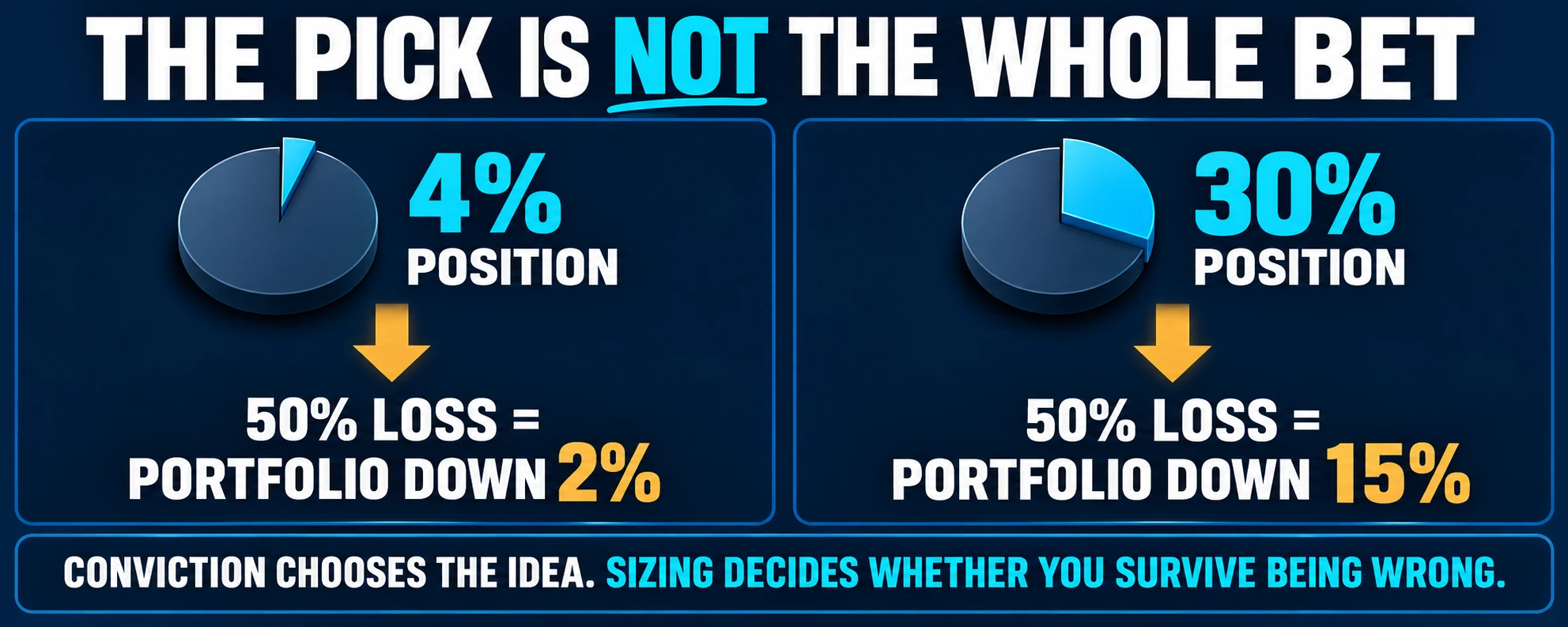
A 4% position cut in half reduces total liquid net worth by roughly 2%. It hurts, but the rest of the portfolio still has room to work. A 30% position cut in half removes 15% of liquid net worth. Recovering that loss may require years, and the investor may be least emotionally able to act when the opportunity is best.
This is why volatility tolerance is not a personality quiz. It is a cash-flow question. Would a deep decline force a sale to cover tuition, taxes, payroll, a house down payment, or retirement spending? If yes, the risk is not merely seeing a red number. It is selling on someone else’s timetable.
A Practical Position-Sizing Process
I do not think there is one correct percentage for everyone. I do think every concentrated position should survive five questions.
1. What is the maximum acceptable damage?
Work backward from portfolio loss, not forward from excitement. If a plausible 50% drawdown should not cost more than 2% of liquid net worth, the starting position is about 4%. That does not say the stock will fall 50%. It says the plan can absorb it if it does.
2. What other exposure behaves like this one?
Add direct shares, overlapping funds, employer stock, options, and business-income exposure. A software employee with company equity and a technology-heavy portfolio is more concentrated than the ticker count suggests.
3. Is the position liquid enough?
Daily trading volume is only part of liquidity. Taxes, lockups, spreads, option expiry, and account restrictions can all change the real exit cost.
4. What would trigger a review?
Write two separate triggers:
- Weight trigger: the position grows beyond its maximum share of liquid net worth.
- Thesis trigger: the evidence underpinning the investment changes.
A rising price can trip the first without harming the second. A flat price can hide a broken thesis.
5. What will I do before emotion arrives?
Choose the review action in advance: trim to target, pause new buying, redirect contributions elsewhere, or reassess the thesis. Rebalancing is easier when it follows a rule rather than a headline. Investor.gov notes that investors commonly rebalance on a time schedule or when allocations move beyond preset bands. Investor.gov
Conviction Is Not a Sizing Formula
“High conviction” describes belief. It does not measure downside.
The best-researched thesis can still meet a recession, accounting surprise, lawsuit, product failure, regulatory change, dilution, or valuation reset. Some risks are visible in filings; others arrive from outside the model. The SEC’s EDGAR database makes 10-Ks, 10-Qs, and 8-Ks available so investors can examine financial statements, risk factors, management discussion, and material events. That research improves a decision. It cannot remove uncertainty. SEC EDGAR guide
My test is blunt: If a position must work for the rest of the plan to work, it is not just an investment thesis. It is a dependency.
The goal is not to make every holding tiny. The goal is to know which outcome you are underwriting. A concentrated investor may knowingly accept larger swings and larger losses. A diversified investor may knowingly give up some upside from a single winner. Both can be rational. Drifting into concentration because a stock rose—or because a story became emotionally important—is not a strategy.
The Bottom Line
Most investors do not have a stock-picking problem. They have a translation problem: they know why they like a company but have never translated that belief into an acceptable amount of portfolio damage.
Do the drawdown math before the purchase. Count overlapping exposure. Size against liquid net worth. Separate the price from the thesis. Write the review rule while calm.
The next stock idea can wait. A portfolio that can survive the wrong idea cannot.
This article is educational and informational only. It is not a recommendation to buy, sell, short, or hold any security, and it does not provide individualized financial, investment, tax, legal, or trading advice. Investing can result in loss of principal. Diversification and position limits do not guarantee gains or prevent losses. Verify current information and consider qualified professionals for decisions specific to you.