
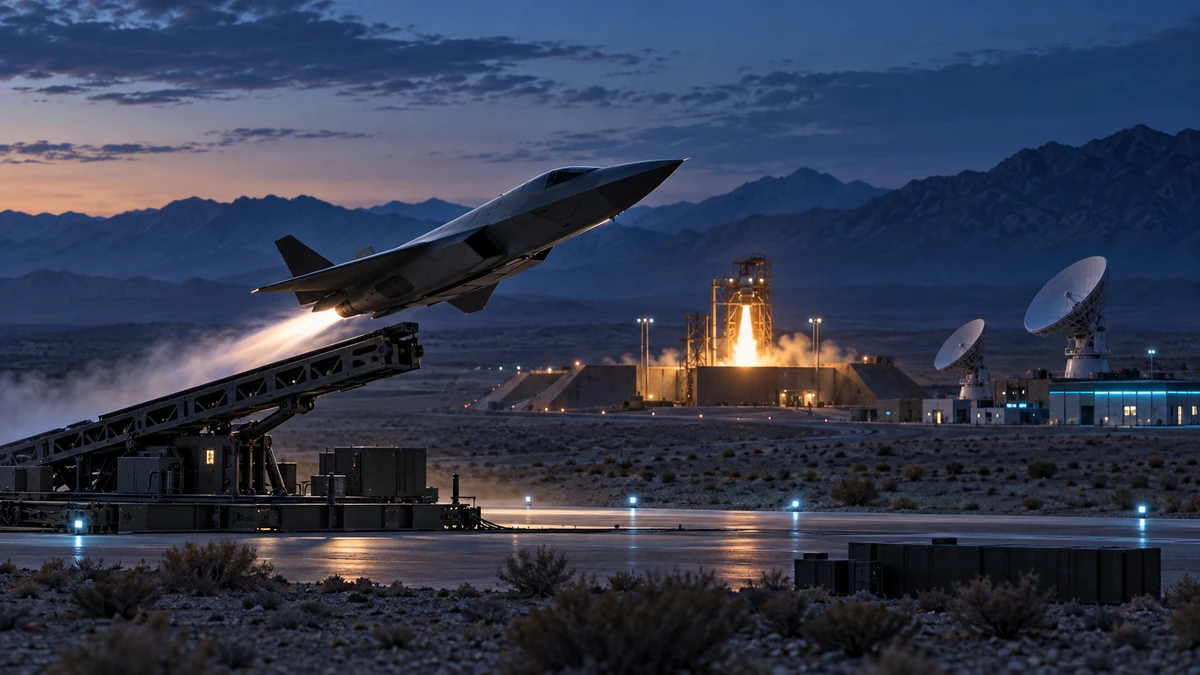
Kratos Defense is usually pitched as the company behind the XQ-58A Valkyrie drone. That is memorable—and incomplete.
The broader business is built around a change in defense procurement: supplementing a few exquisite, extremely expensive platforms with more affordable systems that can be produced faster and deployed in greater numbers. Kratos sells into that shift from several directions, including uncrewed aircraft, small jet engines, rocket motors, hypersonic testing, missile targets, microwave electronics, and satellite ground systems.
That is why I am bullish on the business. But this is not a cheap-stock story. Kratos is spending heavily before production ramps, free cash flow is negative, and shareholders have absorbed meaningful dilution. At $47.66 on September 17, KTOS still traded near 43 times the midpoint of management's 2026 adjusted EBITDA guidance. The bull case depends on today's prototypes, facilities, and funded programs becoming repeat production—with better margins—before the valuation runs out of patience.
Reader note: This article provides general educational and informational content, not individualized financial, investment, tax, legal, or trading advice. Facts and market conditions can change. Verify current information and consider qualified professionals for decisions specific to you.
Research checked through September 17, 2026. Market price is the September 17 close.
The One-Sentence Thesis
Kratos is a picks-and-shovels bet on affordable, scalable defense hardware: not one aircraft winning one competition, but a portfolio of drones, engines, rockets, test systems, and space infrastructure moving from development into production.
Here is the case in one screen:
| Thesis | The receipt | The risk | What to watch |
|---|---|---|---|
| Demand is outrunning current capacity | $2.08 billion backlog and 1.3x trailing book-to-bill | Backlog includes unfunded work and acquired businesses | Funded awards and delivery cadence |
| Kratos is more than Valkyrie | Government Solutions produced 83% of Q2 revenue | The best-known drone business is growing more slowly | Segment backlog and margins |
| Production is beginning to replace prototypes | Full-rate target-drone lots, new propulsion awards, and factory expansion | Demonstrations and development contracts may not convert | Repeat quantities, not contract ceilings |
| The balance sheet can fund the buildout | $1.44 billion cash and no funded long-term debt | Cash was largely raised through equity issuance | Per-share earnings and future dilution |
| Operating leverage is possible | Management targets roughly 100 basis points of adjusted EBITDA margin expansion in both 2026 and 2027 | Q2 GAAP operating margin was still negative | GAAP profit and free-cash-flow inflection |
Financial figures are from Kratos' second-quarter 2026 results and 10-Q. Contract ceilings, options, pipeline, and management production targets are not the same as funded revenue. Q2 results | Q2 10-Q
For the larger technology backdrop, see our breakdown of the eight AI trends shaping autonomy and physical systems and our look at the domestic rare-earth supply chain.
Kratos Is More Than the Valkyrie
The Valkyrie deserves attention. It is a runway-independent, jet-powered uncrewed aircraft designed to carry mission systems without the price or logistics footprint of a crewed fighter. In January, Northrop Grumman selected the Valkyrie air vehicle for the Marine Corps' MUX TACAIR collaborative combat aircraft program. In August, a missionized Valkyrie demonstrated electronic warfare and beyond-line-of-sight command and control while operating with F-35s and F/A-18s. Those are meaningful technical receipts. Marine Corps CCA selection | August flight demonstration
They are not proof that Valkyrie owns the category.
Northrop is the MUX prime and supplies the mission kit and autonomy layer, which means Kratos will not capture every dollar of the system. The U.S. Air Force also chose General Atomics' FQ-42 and Anduril's FQ-44—not Kratos—for Collaborative Combat Aircraft Increment 1 engineering, manufacturing, development, and production. Open architecture makes it easier to combine airframes, sensors, and autonomy from different vendors; it expands the market while reducing lock-in. Air Force CCA award
The stronger thesis begins when we stop treating Kratos as a one-drone company.
Government Solutions generated $379.7 million of Kratos' $458.8 million in second-quarter revenue. Organic growth inside that segment reached 22.0%, led by Defense Rocket Systems at 50.2%, Turbine Technologies at 43.3%, and Microwave Products at 29.5%. Unmanned Systems grew 8.1% organically to $79.1 million. In other words, the less glamorous propulsion, rocket, microwave, cyber, training, and space businesses are already doing most of the financial work.
That mix gives Kratos several routes into the same procurement theme:
- Target drones: The Navy awarded a $61.1 million full-rate production modification for 70 BQM-177A targets and 70 launch kits. Target aircraft are consumed in training and weapons testing, creating repeat demand rather than a one-off demonstration. Navy production award
- Small jet engines: The Kratos-GE Aerospace GEK800 received the F143-ZZ-100 military designation and a development contract as a second-source engine for JASSM. Its J85 engine was also selected to support Boeing's JDAM LR work. Both could become attractive production programs, but development status and long-lead purchases should not be mistaken for guaranteed volume. F143 development | J85 and JDAM LR
- Hypersonic test and propulsion: Kratos leads systems engineering, integration, and testing for MACH-TB 2.0 and is investing in Zeus and Oriole rocket-motor capacity. The program's $1.45 billion headline is the potential value only if all options are exercised—not funded Kratos backlog. MACH-TB 2.0 award
- Space and satellite ground systems: Space Systems Command confirmed a $446.8 million other-transaction agreement for ground management and integration of medium-Earth-orbit missile-warning and tracking systems. Kratos also won more than $20 million for mobile satellite communications gateways in Asia. Here again, milestones and exercised options determine the economics. Space Force award | Mobile SATCOM award
This portfolio matters because defense adoption rarely moves in a straight line. If one tactical drone competition slips, target systems, propulsion, hypersonic testing, or space infrastructure can still grow.
The Procurement Model Is Flipping
Modern defense systems are becoming more software-defined, autonomous, and modular. But software still needs physical capacity: airframes, engines, motors, antennas, secure ground stations, and test ranges. The production base is the bottleneck.
Kratos' unusual strategy is to invest before every customer requirement is fully mature. It funds designs, buys long-lead inventory, owns more of its intellectual property, and builds facilities ahead of high-rate awards. That can shorten delivery times and make the company useful to the government, to larger primes, or as a prime itself. It can also leave shareholders holding expensive capacity if programs change.
The evidence is moving in the right direction. Kratos says its expanded Oklahoma facility lifts current high-performance jet-drone output to roughly 165 aircraft a year across multiple models. Management is procuring toward capacity for 3,000 small jet engines in 2027 and aims to begin producing approximately 40 Valkyries annually by the start of 2028. A new Indiana facility adds hypersonic payload-integration capacity. These are company targets, not customer purchase commitments. Oklahoma expansion | Q2 2026 results
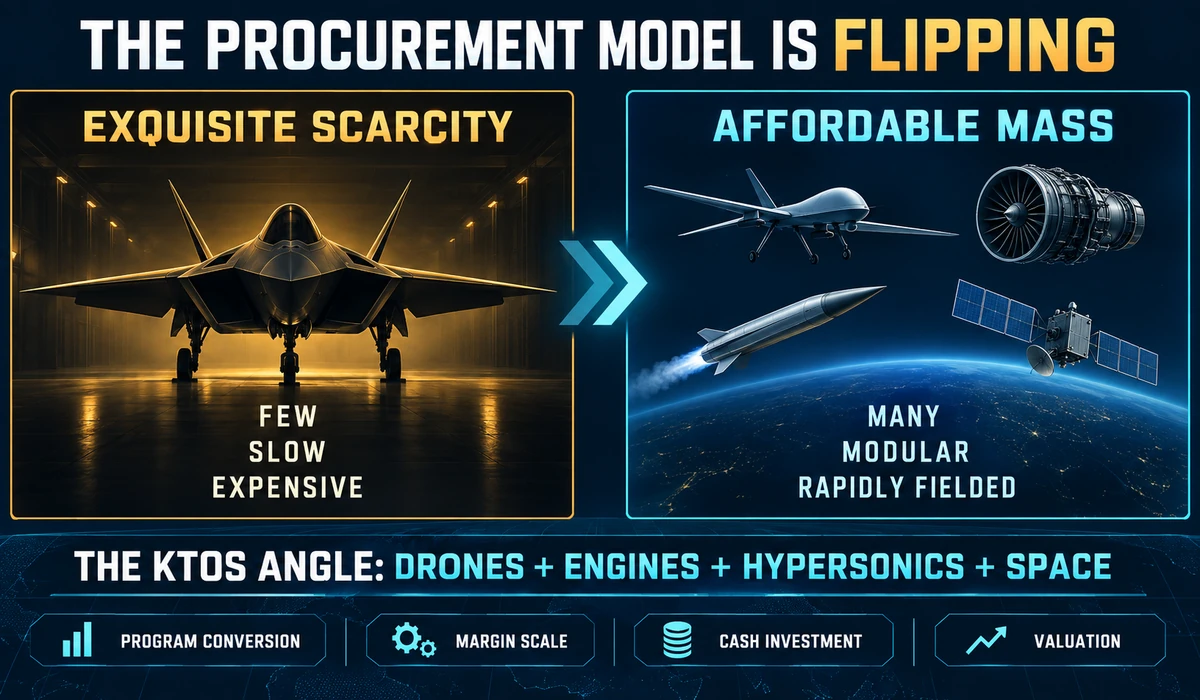
Original MentorSurge visual summary built specifically for this article.
The important distinction is between capacity, opportunity, and orders. Kratos' approximately $15 billion bid-and-proposal pipeline is an opportunity set. IDIQ ceilings and contract options are maximum possible values. Backlog is stronger evidence, but even backlog includes funded and unfunded amounts and may be changed or canceled. The receipts I care about most are funded production quantities, completed milestones, repeat lots, and cash collected after delivery.
The Financial Receipts Are Getting Stronger
Kratos' second quarter showed that the thesis is becoming more than a technology showcase:
- Revenue rose 30.5% to $458.8 million; organic growth was 19.1%.
- Adjusted EBITDA increased 35.0% to $38.2 million.
- Bookings were $492.2 million, producing 1.1x quarterly book-to-bill.
- Trailing-12-month bookings reached $1.99 billion, or 1.3x book-to-bill.
- Backlog reached $2.084 billion, up 47% from $1.414 billion a year earlier.
- Funded backlog was $1.572 billion, about three-quarters of the total.
- Management raised 2026 revenue guidance to $1.75 billion-$1.81 billion and expects organic growth of roughly 18%-23%.
The quality checks matter. Acquired businesses Nomad and Orbit contributed $40.2 million of the quarter's year-over-year revenue increase, so reported growth is not entirely organic. They also contributed roughly $243 million to year-over-year backlog expansion. Within the segments, all sequential net backlog growth came from Government Solutions; Unmanned backlog was almost flat at $374.6 million. The Valkyrie narrative is exciting, but the financial engine remains broader.
Margins are also early. Q2 gross margin improved to 21.8%, and adjusted EBITDA margin was 8.3%. Yet GAAP operating income was negative $1.6 million. The quarter included $16.3 million of stock-based compensation, $13.6 million of company-funded research and development, and $12.5 million of amortization. Those costs help build future products, but the gap between adjusted and GAAP performance is real.
Management expects full-year adjusted EBITDA of $173 million-$176 million, roughly a 9.8% margin at the midpoints. It then targets another approximately 100 basis points of expansion in 2027. That is the operating-leverage test: high-rate production must grow faster than research, overhead, and factory costs.
A Better Entry Price Is Not a Cheap Valuation
The most striking capital-markets fact is this: Kratos sold 16.43 million shares at $84 in February, raising $1.35 billion net. On September 17, the stock closed at $47.66—about 43% below that offering price. Q2 10-Q | Price history
That creates two opposing truths.
The first is bullish. Kratos raised a large pool of growth capital at a much higher stock price. At June 28, it held $1.438 billion of cash, no funded long-term debt, and an almost entirely undrawn $300 million revolver. The company can build factories, carry inventory, fund research, and make selective acquisitions without depending on near-term free cash flow. There were about $140 million of finance-lease liabilities, so “zero debt” should not be confused with zero obligations.
The second truth is dilution. Shares outstanding increased from 168.9 million at year-end to 187.6 million at June 28, an 11.1% rise in six months. Including the June 2025 raise, diluted weighted-average shares in Q2 were 20.8% above the prior year. A bigger company only creates value if revenue, earnings, and cash flow grow faster per share.
At $47.66 and 187.7 million shares, Kratos' basic equity value was about $8.95 billion. Subtracting June cash produces a rough enterprise value of $7.51 billion before finance leases. Against management's 2026 guidance midpoints, that is approximately:
- 4.2x enterprise value to revenue
- 43x enterprise value to adjusted EBITDA
- no useful free-cash-flow multiple, because management expects to use $85 million-$105 million of free cash flow in 2026
These are MentorSurge calculations using the September 17 close, the latest reported share count and cash, and company guidance. The price, share count, and balance sheet will change.
The spending is substantial. Kratos expects $250 million-$275 million of 2026 investment: $125 million-$135 million of capital expenditures, $75 million-$85 million of working-capital investment, and $50 million-$55 million for the Prometheus solid-rocket-motor venture. That may be exactly the right move if production arrives. It is also why the stock requires more than contract announcements. Q2 2026 results
What Would Make Me Wrong—and My Bottom Line
The cleanest way to own an expensive growth stock is to define the evidence that would break the thesis.
- Valkyrie remains a demonstration program. The Marine Corps work needs to become funded quantities, accepted deliveries, and repeat production—not only successful flights.
- Kratos loses follow-on autonomous-aircraft opportunities. General Atomics, Anduril, large primes, and other airframe suppliers have deeper resources, and open architectures reduce lock-in.
- Hypersonic and propulsion headlines fail to convert. MACH-TB options, F143 development, J85 long-lead parts, and motor capacity must become task orders, tests, and production revenue.
- Book-to-bill falls below 1.0x while factories expand. Capacity without replenished demand would pressure returns.
- Margins fail to scale. Roughly 70% of first-half revenue came from fixed-price contracts, so labor, material, schedule, and technical overruns can land on Kratos.
- Free cash flow stays negative beyond the buildout. A temporary investment cycle is acceptable; a structurally cash-hungry model is not.
- Another major equity raise arrives before per-share earnings catch up. The balance sheet is strong because shareholders funded it.
- Government timing turns against the company. Roughly 69% of first-half revenue came from the U.S. government, and those contracts can be delayed, reprioritized, or terminated for convenience.
Near-term checkpoints include funded MUX quantities, the Valkyrie production lot, hypersonic flight cadence, F143 and J85 production decisions, Space Force program milestones, Unmanned segment backlog, adjusted-margin expansion, and the path to positive free cash flow.
My bottom line is simple: Kratos is one of the most direct public-market bets on affordable mass across modern defense. Its advantage is breadth. Valkyrie opens the door, but target drones, engines, rocket systems, hypersonic test infrastructure, microwave electronics, and satellite ground systems make the business more resilient than the headline suggests.
I am bullish because demand is real, organic growth is accelerating, backlog is substantial, and Kratos has the capital to build before competitors can. I am cautious because the valuation still assumes successful program conversion and meaningful margin expansion. The stock does not need another impressive demonstration. It needs production receipts—and then cash flow.
For investors who prefer diversified exposure around space and advanced technology, our comparison of VTI, QTUM, and the NASA ETF offers a lower-company-specific-risk alternative.
This article is educational and informational only. It is not a recommendation to buy, sell, short, or hold Kratos Defense or any other security. Investing can result in loss of principal. Company guidance, market prices, contracts, and industry conditions can change; verify the latest quote and filings before making a decision.