

The 10-year Treasury yield closed Friday at 5.01%. That is not a prediction. It is the official U.S. Treasury par-curve reading for September 18.
During the same week, the Federal Reserve raised its policy target by a quarter point to 3.75%-4.00%. The Nasdaq Composite still gained 0.7%. The Dow fell 1.7%. If the lesson is “rates up, stocks down,” the week refused to cooperate.
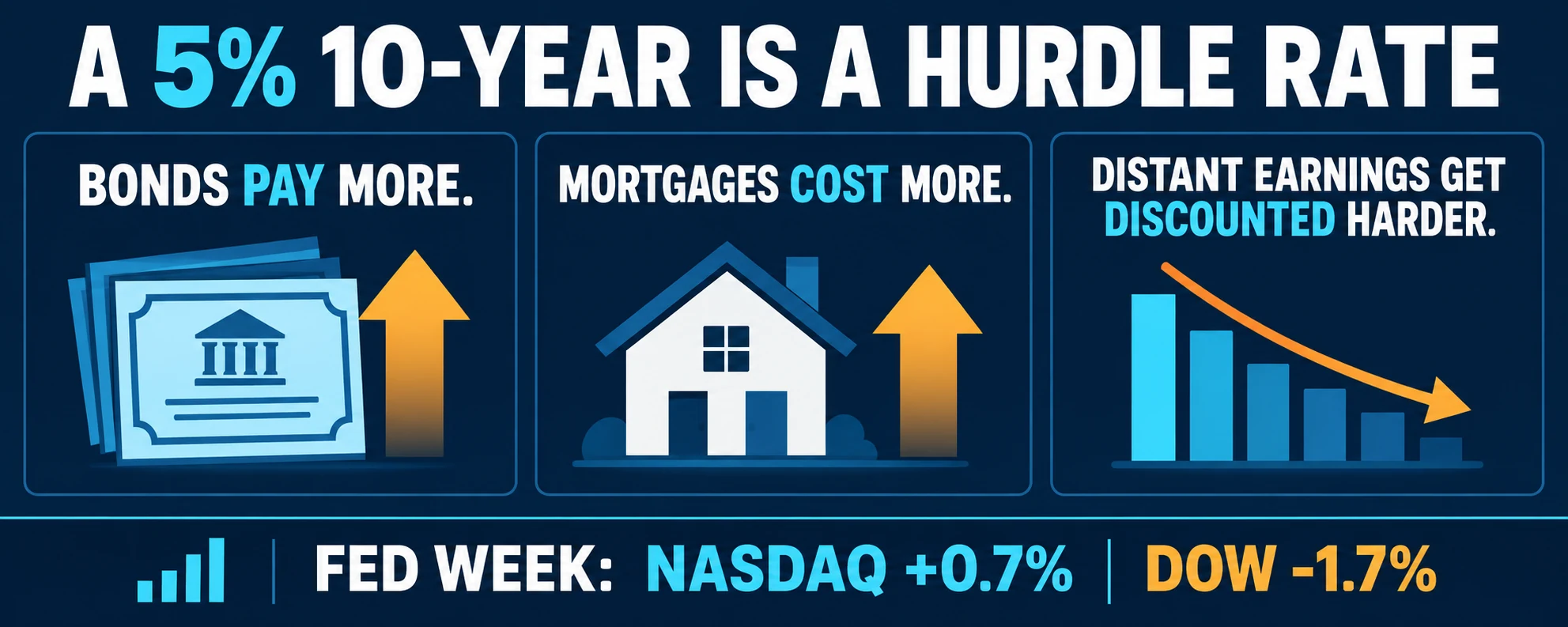
The better lesson is that a 5% 10-year changes the hurdle rate across the economy. It makes safe nominal income more competitive, raises the discount applied to future earnings, and feeds into borrowing costs. It does not determine every asset price by itself, and it does not tell us where the Fed moves next.
Reader note: This article provides general educational and informational content, not individualized financial, investment, tax, legal, mortgage, or trading advice. Rates and markets change continuously. Figures below use official and published data available through September 18, 2026.
Research checked through September 21, 2026. Market closes and yield data are for the week ended September 18.
The One-Sentence Thesis
A 5% 10-year Treasury raises the price of time: future cash flows must work harder, borrowers pay more, and every risky asset competes with a credible bond return.
The week in one screen:
| Measure | Monday, Sep. 14 | Wednesday, Sep. 16 | Friday, Sep. 18 | Weekly message |
|---|---|---|---|---|
| 10-year Treasury par yield | 4.97% | 5.01% | 5.01% | The long rate held near 5% |
| Fed target range | 3.50%-3.75% before meeting | Raised to 3.75%-4.00% | 3.75%-4.00% | Policy rate moved up 25 bps |
| Nasdaq Composite | — | — | 26,522.55 | +0.7% for the week |
| Dow Jones Industrial Average | — | — | 51,682.64 | -1.7% for the week |
| 30-year fixed mortgage average | — | — | 6.95% as of Thursday | Up from 6.76% one week earlier |
The Treasury’s daily closes were 4.97%, 5.00%, 5.01%, 4.94%, and 5.01% from Monday through Friday. Treasury explains that these constant-maturity yields are derived from indicative bid-side prices near 3:30 p.m., not from a single bond transaction. U.S. Treasury
The Federal Reserve’s September 16 statement raised the target range by 25 basis points and said inflation remained elevated. It did not promise the next move. Federal Reserve
First Change: Cash Flows Far Away Are Worth Less Today
Stock valuation converts future cash flows into a present value. The discount rate is the price of waiting and taking risk. When a Treasury bond offers roughly 5% before credit or equity risk, investors can demand more from a stock.
A simplified example shows the direction. One dollar received ten years from now is worth about 61 cents today at a 5% discount rate. At 4%, it is worth about 68 cents. Nothing changed about the future dollar. The price of waiting changed.
That sensitivity is larger for companies whose expected value sits far in the future. A mature business producing cash now has less duration than a company priced on profits many years away. That is why higher long rates often pressure high-multiple growth stocks.
Often is not always.
Earnings expectations can rise faster than discount rates. A company can report better margins, win a large customer, or guide higher. Investors can also believe that a rate move reduces uncertainty even when the move itself is restrictive. A valuation model has more than one input.
Why the Nasdaq Could Rise While the Dow Fell
The Nasdaq gained 0.7% for the week ended September 18 while the Dow lost 1.7%. On Friday alone, the Nasdaq rose 0.4% and the Dow fell 0.2%, even as the 10-year returned to about 5%. Associated Press
That does not mean the Nasdaq stopped caring about yields. It means index labels hide company-level forces.
The Nasdaq is more exposed to large technology and growth companies. Those businesses can be duration-sensitive, but some also have strong balance sheets, net cash, recurring revenue, and earnings revisions powerful enough to offset rate pressure. The Dow is price-weighted and holds a different industry mix. Industrial, financial, health-care, and consumer names respond differently to oil, credit, demand, regulation, and company news.
Thursday makes the point. The 10-year yield eased to 4.94%; the Nasdaq jumped 1.7% and the Dow rose 0.6%. One day later, the long yield returned to 5.01%, but the Nasdaq still edged higher while the Dow slipped. Associated Press, September 17 | U.S. Treasury
The clean conclusion is not “buy tech.” It is that a Treasury yield is a major input, not a complete market model.
Second Change: Mortgages Stay Expensive
The 10-year Treasury does not set mortgage rates by decree. Thirty-year mortgages include duration, prepayment, credit, servicing, capital, and market-spread considerations. But the long Treasury market is an important benchmark.
Freddie Mac’s weekly survey showed the average 30-year fixed mortgage at 6.95% on September 17, up from 6.76% a week earlier. The 15-year average rose to 6.26% from 6.09%. Freddie Mac
The payment effect is tangible. On a $400,000 30-year fixed loan, principal and interest are roughly:
- $2,524 a month at 6.5%
- $2,649 a month at 7.0%
That approximate $125 monthly gap is $1,500 a year before taxes, insurance, maintenance, or fees. It changes purchasing power even if the home price does not move.
For sellers, high rates can reduce buyer budgets. For existing owners with lower fixed mortgages, high current rates can discourage moving, limiting supply. For builders, affordability pressure can require incentives or smaller products. The housing response is therefore not one clean line from yields to prices.
Third Change: The Comparison Set Gets Harder
At a 5% 10-year yield, investors are paid a meaningful nominal return to hold a U.S. government obligation to maturity. That changes the conversation for dividend stocks, real estate, private deals, and expensive public equities.
It does not make Treasuries risk-free in every sense. Bond prices move when yields change, inflation can erode purchasing power, and selling before maturity can lock in a loss. It does provide a higher baseline against which other assets must be judged.
For stocks, I would ask:
- What is the current earnings or free-cash-flow yield?
- How fast can those cash flows grow per share?
- How cyclical or uncertain are they?
- What multiple must the market pay at the end of the holding period?
- Is the expected premium over Treasuries large enough for the risk?
This is where valuation risk and thesis risk must stay separate. A company can keep executing while its valuation compresses because the alternative return improved.
What 5% Does Not Tell Us
A 5% 10-year does not tell us:
- whether the next Fed move is a hike, hold, or cut;
- whether inflation will reaccelerate or cool;
- whether the Nasdaq or Dow wins next week;
- whether mortgage spreads widen or narrow;
- whether a specific company will beat earnings expectations;
- whether 5% becomes support, resistance, or a brief stop.
The Fed controls its short-term target range. The 10-year reflects a market judgment about future short rates, inflation, growth, term premium, supply, and demand. They influence each other, but they are not the same rate.
That is why I would not turn one Fed meeting into a rate call. The September projections are conditional assessments, not promises, and the official material explicitly frames them around participants’ views of appropriate policy under uncertain future conditions. Federal Reserve projections
The Bottom Line
A 5% 10-year changes the hurdle rate.
It makes future earnings less valuable today, keeps mortgage affordability under pressure, and forces risky assets to compete with a real nominal bond yield. But it does not push every stock in the same direction on the same day. Fed week proved that: the long yield finished at 5.01%, the Nasdaq gained, and the Dow fell.
Use the 10-year as a price for time—not as a fortune teller.
This article is educational and informational only. It is not a recommendation to buy, sell, short, or hold any security or to enter any mortgage or lending transaction, and it does not provide individualized financial, investment, tax, legal, or trading advice. Investing can result in loss of principal. Rates, prices, and economic conditions can change quickly; verify current information before making a decision.