Why I'm Still Bullish on NVIDIA at $217
The stock sits 11% below its October high while the business just guided to another record quarter. Here is the math behind my call, and what would prove me wrong.

Price: $217.12 at 1:53 p.m. ET on October 28, 2026 (Nasdaq, via the MentorSurge quote feed). Company figures come from NVIDIA's SEC filings through the quarter ended July 26, 2026.
My call, in plain words
I’m bullish on NVIDIA at $217. Not because the stock can’t fall. It can, and it has. I’m bullish because the price looks like it assumes growth is about to stall, and NVIDIA’s own numbers don’t show that yet.
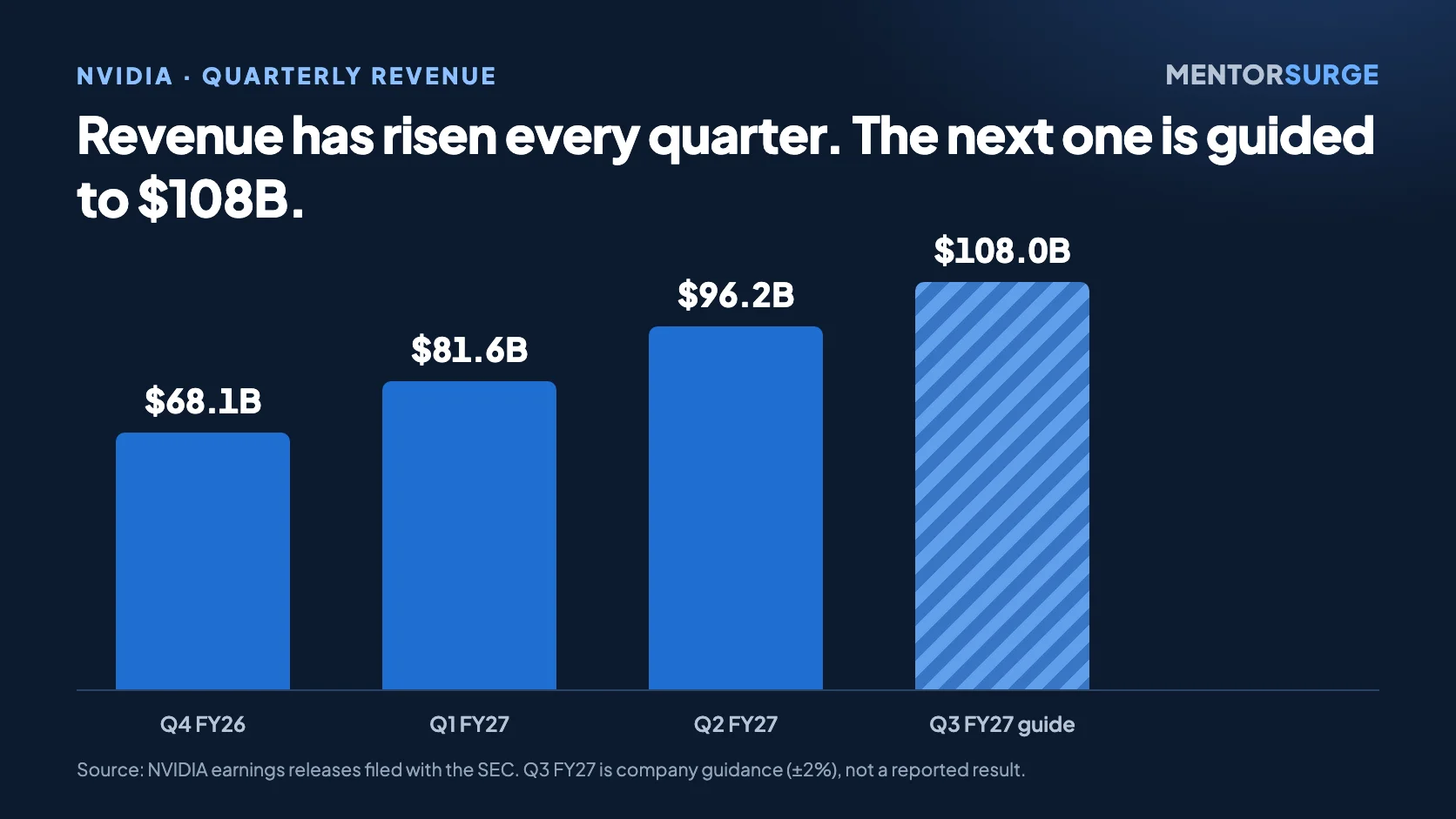
The stock traded as high as $243.37 on October 6. It’s now about 11% lower. Over the same stretch, nothing in the company’s reported results got worse, and its guidance for the October quarter is another record: $108 billion of revenue.
This is my opinion and my reasoning, laid out so you can check every number. It’s not a recommendation to buy or sell, and it doesn’t know your situation.
Disclosure: I own NVDA shares. Read my view with that in mind.
The numbers that matter
In the quarter ended July 26, revenue rose 106% from a year earlier to $96.2 billion. Data center revenue alone was $89.0 billion, up 117%.
| Quarter | Revenue | Gross margin | Adjusted EPS |
|---|---|---|---|
| Q4 FY26 (ended Jan 25, 2026) | $68.1B | 75.1% | $1.59 |
| Q1 FY27 (ended Apr 26, 2026) | $81.6B | 75.0% | $1.87 |
| Q2 FY27 (ended Jul 26, 2026) | $96.2B | 75.0% | $2.22 |
| Q3 FY27 guidance | $108.0B ±2% | 74.0% ±0.5 pts | Not guided |
One thing to know: starting this fiscal year, NVIDIA’s adjusted (non-GAAP) numbers include stock-based compensation, and the company restated earlier quarters to match. That’s why the January quarter shows $1.59 here instead of the $1.62 first reported. I only compare numbers on the current definition.
What $217 is actually paying for
At $217.12, NVIDIA is worth about $5.27 trillion, using the 24.3 billion diluted shares from the July quarter. Here are two simple ways to see what that buys.
- Last quarter, annualized. $2.22 × 4 = $8.88 of adjusted earnings per share. $217.12 ÷ $8.88 = 24.5 times earnings.
- Next quarter’s guidance, annualized. NVIDIA guided $108.0 billion of revenue at a 74% gross margin, with about $9.0 billion of adjusted operating expenses. Add $0.5 billion of other income (it was $0.46 billion in the April quarter), tax it at 17% (the middle of NVIDIA’s 16% to 18% outlook) and divide by 24.3 billion shares. That’s about $2.44 a share for the quarter, or $9.76 a year, which puts the stock at about 22 times.
That second figure is my own arithmetic from the company’s guidance, not a forecast and not Wall Street’s estimate. It frames the question well, though: you’re paying roughly 22 times a run rate for a business whose revenue more than doubled in a year.
Cash backs it up over a longer window. Free cash flow across the last four reported quarters added up to $126.9 billion, about 2.4% of the company’s market value.
The stock is priced like growth is about to stall. The guidance says it hasn’t.
Why I’m bullish
1. Demand is spreading, not narrowing
In NVIDIA’s August release, CEO Jensen Huang said that a year ago one AI lab was driving the buildout, and that now several frontier labs, new AI startups and open-model developers are scaling at the same time. His short version: “Now, compute is revenue.” The company also said its next platform, Vera Rubin, is in full production, with racks running at CoreWeave, Google Cloud, Microsoft Azure, Oracle Cloud Infrastructure and Nebius. More buyers make demand harder to switch off.
2. Margins held through a product change
Gross margin was 75.0% in both the April and July quarters while Vera Rubin moved into production, and guidance for the October quarter is 74%, plus or minus half a point. Hardware companies often give up margin during a big product transition. So far, NVIDIA hasn’t.
3. China isn’t in the number
NVIDIA’s guidance assumes no data center compute revenue from China. If sales there resume, that’s upside the guidance doesn’t include. If they don’t, nothing in the guidance changes. I’m not counting on it either way.
4. The earnings got more conservative, and the buyback is real
Counting stock-based compensation as a cost made NVIDIA’s adjusted earnings smaller, not bigger. I like that. The company also returned about $26.0 billion to shareholders in the July quarter through buybacks and dividends, and had $99.0 billion of buyback authorization left.
The bear case I take seriously
Being bullish doesn’t mean ignoring these.
- Cash lagged earnings last quarter. In the July quarter, NVIDIA reported $59.7 billion of net income but only $24.1 billion of operating cash flow. Two reasons stand out: $7.8 billion of that net income came from gains on equity investments, which isn’t cash, and accounts receivable rose $22.3 billion, meaning customers owed a lot more at quarter end. If receivables keep climbing faster than revenue, that’s a warning.
- Peak-cycle pricing. Chip stocks often look cheapest on paper right when earnings peak. A 22 times multiple is only cheap if the earnings hold up.
- Financing behind the demand. NVIDIA announced partnerships with Apollo, BlackRock, Blackstone, Brookfield, Goldman Sachs and KKR aimed at mobilizing over $500 billion of outside capital for AI infrastructure, subject to final agreements. That can widen the market. It can also mean some demand depends on financing staying available.
- Competition and physical limits. Big cloud companies design their own chips, rivals like AMD are pushing hard, and the whole buildout depends on memory supply, chip packaging and power.
- The stock moves a lot. From its March 30 low of $164.27 to its October 6 high, NVIDIA rose 48%. Moves that size cut both ways.
Three ways this could play out
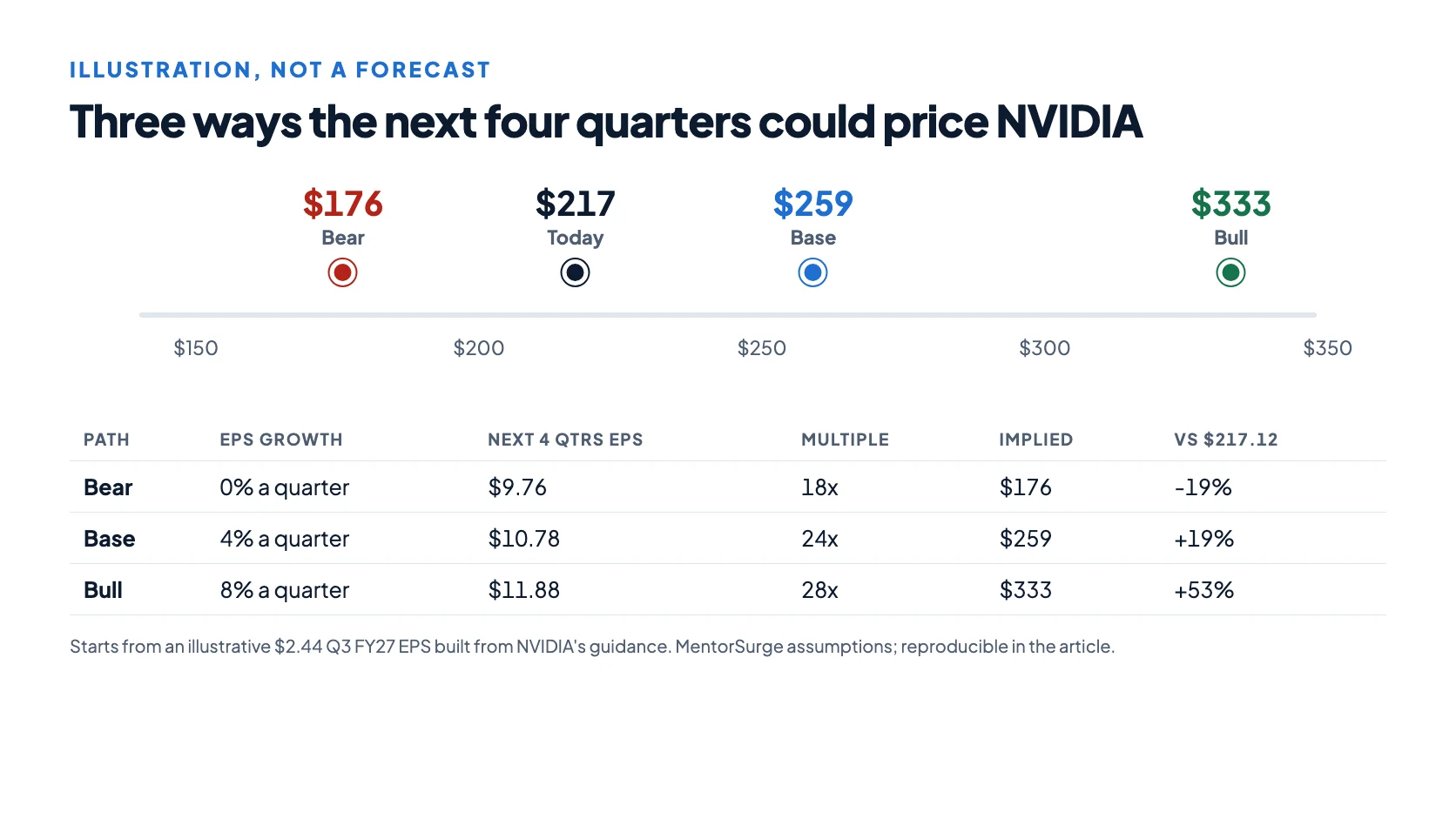
| Path | Growth a quarter | Next 4 qtrs EPS | Multiple | Implied | vs today |
|---|---|---|---|---|---|
| Bear | 0% | $9.76 | 18x | $176 | −19% |
| Base | 4% | $10.78 | 24x | $259 | +19% |
| Bull | 8% | $11.88 | 28x | $333 | +53% |
These are illustrations of the math, not predictions. Here’s why they push me to the bullish side: the bear case needs growth to stop completely and the multiple to shrink at the same time. The base case only needs modest growth and a multiple close to the 24.5 times the stock trades at on last quarter’s earnings. From here, I think the upside is bigger than the downside.
Price levels I’m watching
These come from the daily price history. They’re reference points, not buy or sell instructions.
- $243.37: the October 6 high. A move back above it would say the pullback is over.
- About $222 to $224: the 50-day and 20-day moving averages as of October 27. The stock is below both, which is what a short-term pullback looks like.
- $210.18: the October 23 low, the bottom of this pullback so far.
- About $204: the 200-day moving average. The longer trend stays up while the price holds above it.
- $164.27: the March 30 low, where the last big shakeout ended.
You can check these yourself on the MentorSurge stock charts.
What would change my mind
NVIDIA is expected to report its October quarter on November 17, the date it gave on its August earnings call. My scorecard:
- Revenue below $105.8 billion, the bottom of the guided range.
- Gross margin below 73.5%.
- Guidance for the January quarter that isn’t higher than the October quarter.
- Receivables growing faster than revenue again, with operating cash flow still far below net income.
- Major cloud customers cutting their spending plans.
One of these I could live with. Two or three together, and I’d treat the bull case as broken.
Bottom line
At $217, NVIDIA trades around 22 times an earnings run rate built from its own guidance while its revenue doubles. The risks are real, and the cash-flow gap is the one I’ll watch most closely on November 17. But the price looks like it already assumes a slowdown the company hasn’t reported. That’s why I’m bullish.
Before you act on any single stock: work through Risk, Time Horizon, and Why Next Year’s Money Is Different and diversification and fees. One stock, however good, is still one stock.
Sources
- NVIDIA second-quarter fiscal 2027 results (SEC, August 26, 2026)
- NVIDIA first-quarter fiscal 2027 results (SEC)
- NVIDIA fourth-quarter and fiscal 2026 results (SEC, February 25, 2026)
- NVIDIA Q2 fiscal 2027 earnings call transcript (November 17 call date)
- Nasdaq NVDA price history, used for the price, moving averages and 52-week range
Disclosure: the author, Joe, owns NVIDIA (NVDA) shares. Educational commentary and opinion only, not individualized investment, tax, or legal advice, and not a recommendation to buy or sell any security. Investing involves risk, including loss of principal. Scenarios are illustrations of arithmetic, not forecasts. Prices and company figures carry the dates shown and may change or be revised.