AI Is Not Dead. We're Still in the Building Phase.
Tech stocks just had their worst day since June and the bubble talk is loud again. Here is what the companies actually reported this week, and why I think patient investors will be rewarded.

Prices: closes on October 30, 2026 (Nasdaq daily history, via the MentorSurge quote feed). Company figures come from results filed with the SEC from October 21 to 29, 2026. Full-year plans for Alphabet and Microsoft come from CNBC's reports on their earnings calls.
My view, in plain words
AI is not dead. I don’t think the spending is anywhere near done, and I think we’re still early in the building phase. The people calling AI dead this week are pointing at a real risk, cash flow, and drawing the wrong conclusion from it.
Tech stocks had a rough week. On Friday, October 30, the Nasdaq fell 2.9% and the S&P 500 fell 1.8%, the worst day for both since June. The headlines say AI spending is out of control and the payoff isn’t coming.
I read the actual earnings reports. They say something different: the biggest companies in the world are spending more, not less, and the money is starting to come back as revenue. Here’s what I see, the risks I take seriously, and why I think patient investors get paid for sitting through this.
This is my opinion, not a recommendation to buy or sell anything, and it doesn’t know your situation.
Disclosure: I own NVDA shares and may own other stocks named here. Read my view with that in mind.
What happened this week
Four of the biggest AI spenders reported results between October 21 and October 29. The market didn’t like the bill.
- Alphabet fell 12.6% on October 29, the day after it reported negative free cash flow of $9.1 billion for the quarter. In plain terms, it spent more cash on data centers than the business brought in.
- Intel fell 28.6% on October 30 after a weak outlook for the fourth quarter.
- Chip stocks fell hard. The semiconductor fund SMH dropped 7.0% on October 30. NVIDIA closed at $204.64, 14.5% below its October 6 close.
| Stock or fund | Close, Oct 30 | Highest close, past year | From that high |
|---|---|---|---|
| Nasdaq 100 (QQQ) | $690.49 | $759.66 (Oct 6) | −9.1% |
| S&P 500 (SPY) | $755.72 | $779.09 (Oct 6) | −3.0% |
| Chip stocks (SMH) | $522.49 | $668.91 (Jun 22) | −21.9% |
| NVIDIA | $204.64 | $239.24 (Oct 6) | −14.5% |
| Microsoft | $521.91 | $543.45 (Oct 13) | −4.0% |
| Alphabet | $279.84 | $402.62 (May 13) | −30.5% |
| Amazon | $240.35 | $284.02 (Aug 3) | −15.4% |
| Meta | $614.99 | $777.59 (Sep 24) | −20.9% |
Notice what the worry actually is. Nobody is saying these companies stopped using AI or that customers walked away. The worry is the cost: how much they’re spending, and how they’re paying for it. That’s a fair question. It’s not the same as AI being dead.
The spending isn’t slowing. It doubled.
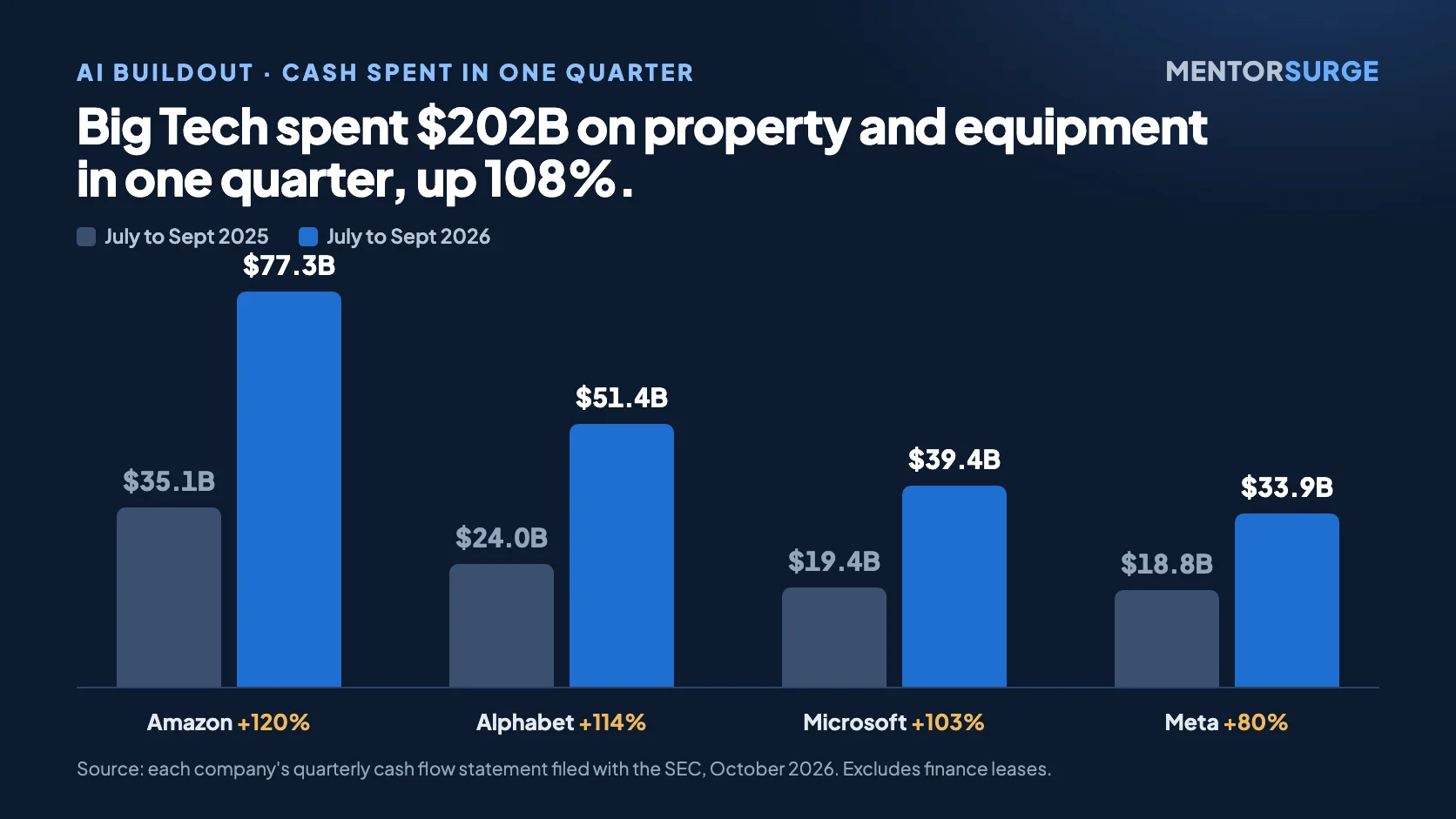
Here’s the cash each company spent on property and equipment, mostly data centers, chips and servers, in the July to September quarter. These come straight from their cash flow statements.
| Company | July to Sept 2025 | July to Sept 2026 | Change |
|---|---|---|---|
| Amazon | $35.1B | $77.3B | +120% |
| Alphabet | $24.0B | $51.4B | +114% |
| Microsoft | $19.4B | $39.4B | +103% |
| Meta | $18.8B | $33.9B | +80% |
| Total | $97.3B | $201.9B | +108% |
That’s about $202 billion in three months, more than double a year earlier. And the plans for the full year held up:
- Amazon still expects about $220 billion of cash capital spending in 2026.
- Alphabet kept its range of $195 billion to $205 billion, according to CNBC’s report on the call.
- Meta narrowed its range to $135 billion to $145 billion, raising the low end from $130 billion. It also said it expects “to continue investing aggressively” next year.
- Microsoft trimmed its plan to about $170 billion from $175 billion. The reason matters. CNBC reported that finance chief Amy Hood pointed to delays at outside GPU suppliers, which push some capacity into the first half of 2027, when she expects spending to speed up.
Read that last one again. Microsoft isn’t spending less because demand dried up. It’s spending a little less this year because it can’t get the hardware fast enough. Looking further out, Evercore and Bank of America estimate AI-related spending will reach about $1 trillion in 2027, as reported by Fortune.
When the builders are waiting on parts, the build isn’t over.
The money is coming back as revenue
Spending only matters if customers pay for what gets built. This quarter, they did.
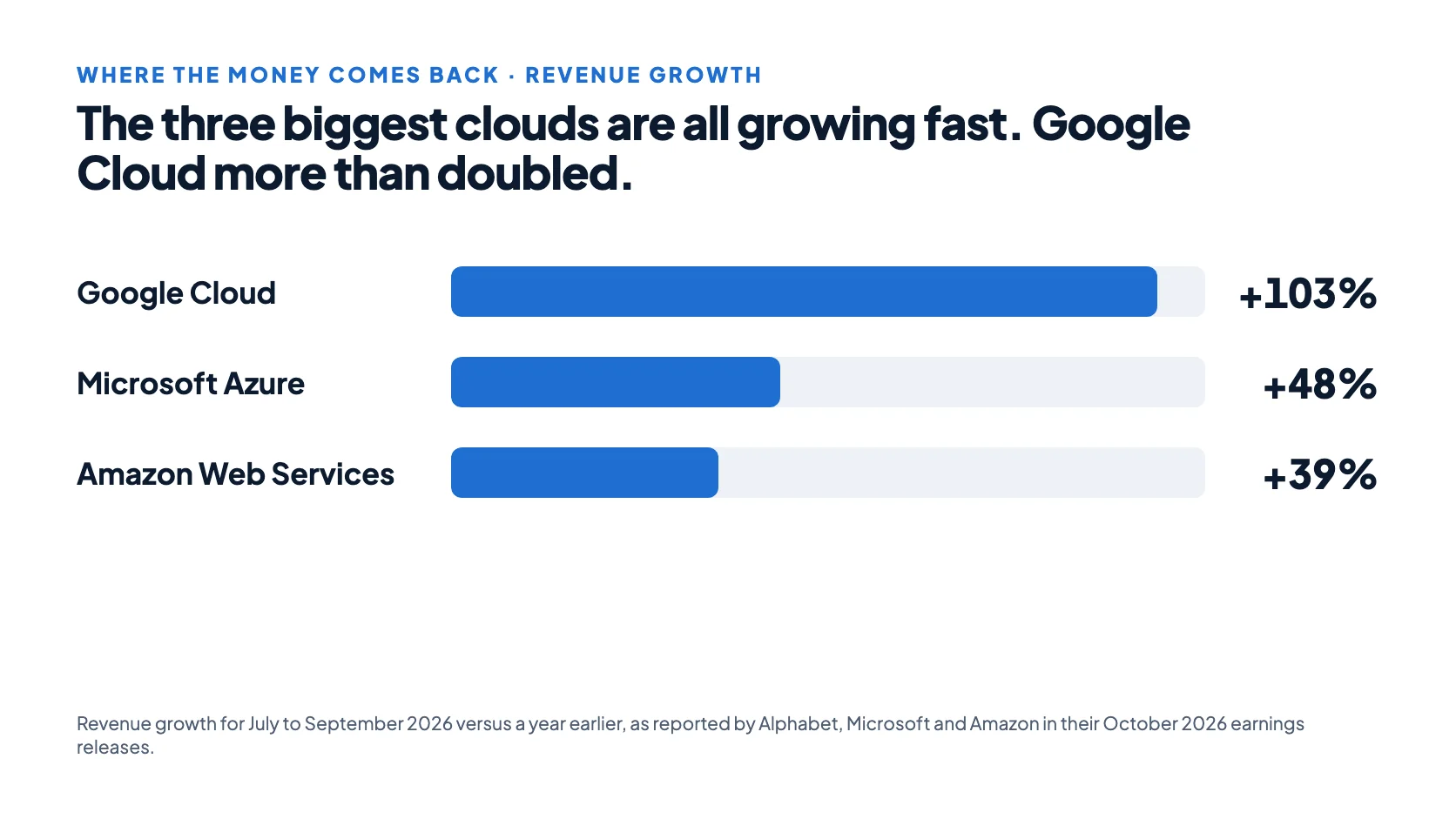
- Google Cloud revenue rose 103% from a year earlier to $30.7 billion. Alphabet credited AI infrastructure, AI products and sales of its own TPU chips.
- Microsoft Azure revenue rose 48%. Microsoft’s commercial backlog, the business customers have already signed up to pay for, jumped 73% to $677 billion.
- Amazon Web Services revenue rose 39% to $46.0 billion, its fastest growth in nearly five years. CEO Andy Jassy said Amazon projects AWS growth of over 40% in both 2027 and 2028.
- Meta grew revenue 26% and said its AI investments “are already delivering substantial incremental advertising revenue.”
Usage is climbing even faster than revenue. Google says its AI models now process nearly 32 billion tokens a minute (a token is a small chunk of text), more than four times what they handled a year ago, and the Gemini app has reached one billion users. Amazon says token volume on Bedrock, its AI service for businesses, grew nearly 17 times in a year.
That’s what the early part of a buildout looks like to me: usage first, revenue next, profits after that.
Why I call this the building phase
Three things tell me we’re closer to the start than the end.
1. Demand is still bigger than supply
Microsoft is waiting on chips. Alphabet’s finance chief, Anat Ashkenazi, said outside computing power “came online only at the very end of Q3.” When the biggest buyers in the world can’t get enough capacity, the cycle hasn’t peaked.
2. The buyers are spreading out
Amazon listed new AWS agreements this quarter with Meta, NVIDIA, OpenAI, Salesforce, Oracle and many more. Microsoft’s $677 billion backlog is signed business, not hope. The more customers commit, the harder demand is to switch off.
3. Big buildouts pay off over years, not quarters
Railroads, electricity and the internet all needed huge spending up front, drew a lot of doubt along the way, and paid off over years. AI looks like that kind of buildout to me. We’re in the part where the bills are big and the payback is just starting to show.
The bear case I take seriously
Being bullish doesn’t mean ignoring the bill. These are the real risks.
- Cash flow went negative. Alphabet’s free cash flow was negative $9.1 billion for the quarter, and Meta’s was negative $2.1 billion. Amazon’s was negative $42.4 billion over the last twelve months. Microsoft is the exception: $58.0 billion of operating cash flow against $39.4 billion of spending on property and equipment left about $18.6 billion.
- Outside money is now part of the plan. This week Meta sold new preferred stock that converts into common shares and lined up the sale of 40 million more common shares. It also announced a new class of non-voting stock, partly to raise capital. When the richest companies start raising outside money for the build, watch who’s lending and at what price.
- Some builders won’t make it. Smaller AI cloud companies carry heavy debt, and CNBC cited a Gartner prediction that by 2030, 80% of these “neocloud” companies will be absorbed or shut down. A real buildout can still sink some of the companies doing the building.
- Right on the technology isn’t the same as right on the price. The internet changed everything, and the Nasdaq still took 15 years, from March 2000 to April 2015, to close above its dot-com peak again. Patience works best when you didn’t overpay and didn’t bet everything on one name.
- Physical limits and interest rates. The build needs chips, memory, power and affordable money. A jump in rates or a power shortage could slow it down.
What patience means to me
I believe the patient will be rewarded here. But patience isn’t the same as holding anything and hoping. Patience that works has a few rules:
- Own it at a size you can sit through. AI stocks can drop 20% or 30% without anything breaking in the business. Alphabet is already 30.5% below its May high. If a drop like that would force you to sell, the position is too big for you.
- Use money you won’t need soon. Money for next year’s bills doesn’t belong in the most volatile part of the market. Risk, Time Horizon, and Why Next Year’s Money Is Different walks through why.
- Spread it out. Chips, cloud and the companies using AI all ride the same trend in different ways. Diversification and Fees covers the basics.
- Judge the business, not the headline. A red week in the stock tells you about the mood. The earnings reports tell you about the business.
What would change my mind
The next checkpoint is NVIDIA’s report, expected November 17. Across all of these companies, I’m watching for:
- A big spender cutting its plan because of weak demand, not because of supply delays.
- Cloud growth slowing for two quarters in a row at Google Cloud, Azure and AWS together.
- Microsoft’s backlog shrinking instead of growing.
- Borrowing costs for AI builders jumping, or stock and bond sales for the build failing to find buyers.
- Customers saying AI isn’t paying for itself and cutting their budgets.
None of those showed up in this week’s reports. The bill went up. So did the revenue.
Bottom line
AI is not dead. The four biggest spenders put about $202 billion into the build in one quarter, kept or raised their plans for the year, and reported cloud growth of 39% to 103%. The cash-flow worry is real, and I’ll keep watching it. But one bad week doesn’t end a buildout this size. I think we’re still in the building phase, and I think the investors who stay patient, sized right and spread out, will be glad they did.
More on the AI trade: Why I’m Still Bullish on NVIDIA at $217, AI Data Centers Need Power: The Next Trade After Chips and The 8 AI Trends That Matter Most Right Now.
Sources
- Amazon third-quarter 2026 results (SEC, October 29, 2026)
- Alphabet third-quarter 2026 results (SEC, October 28, 2026)
- Microsoft first-quarter fiscal 2027 results (SEC, October 28, 2026)
- Meta third-quarter 2026 results (SEC, October 21, 2026)
- Meta Form 8-K on its preferred stock and common stock offerings (SEC, October 29, 2026)
- AI buildout hits snag as Google and Microsoft put off raising capex forecasts (CNBC, October 29, 2026)
- Fears over $828 billion AI capex spending spree help wipe $1 trillion from Nasdaq 100 (Fortune, October 31, 2026)
- Nasdaq surpasses internet bubble peak to set new record (Fortune, April 23, 2015)
- Nasdaq daily price history, used for every price and percentage move in the table
Disclosure: the author, Joe, owns NVIDIA (NVDA) shares and may hold positions in other companies discussed. Educational commentary and opinion only, not individualized investment, tax, or legal advice, and not a recommendation to buy or sell any security. Investing involves risk, including loss of principal. Prices and company figures carry the dates shown and may change or be revised.