
Tesla owns 18,990,195 shares of SpaceX Class A common stock as of May 1, 2026. At the projected $1.75 trillion to $2 trillion SpaceX IPO valuation on June 12, that stake is worth $4 to $5 billion. Tesla shareholders are getting a free option on SpaceX they did not pay for. That single fact is enough to make me ignore most of the panic content flooding my feed this week.
Before we go further, a scope note. This is not my full Tesla bull case. I have written that elsewhere, the robotaxi math, the energy business, all of it. This post is about one specific event: the SpaceX IPO on June 12, the fear trade around it, and why I think the market is reading the event backwards.
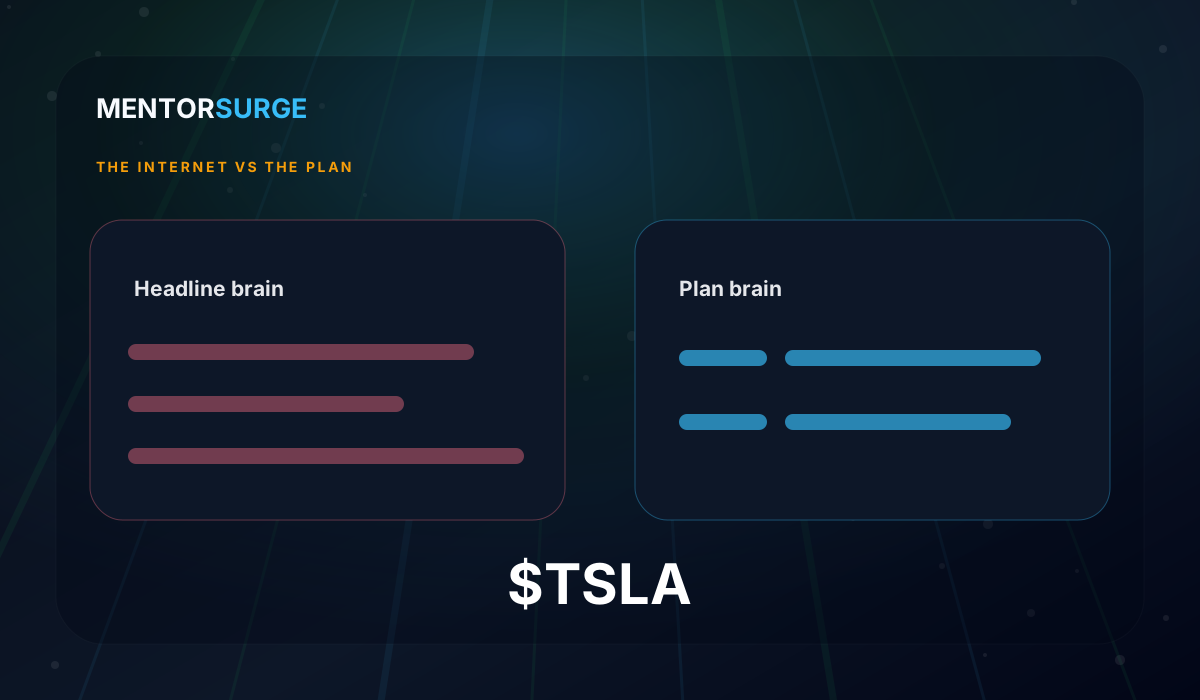
The panic narrative, item by item
The headline version of the bear case is simple. Musk has a shiny new public company, attention rotates, retail money rotates, Tesla bleeds. Fortune literally ran "SpaceX is his new baby at the expense of Tesla." Catchy. Also incomplete.
That framing ignores three things. First, the Tesla balance sheet just got marked up $4 to $5 billion via the SpaceX shares. The "distraction" the bears fear is an asset Tesla holders own a piece of. Second, Optimus is now the most important product Tesla has ever built, with Musk targeting 1 million units per year at Fremont by late 2026. Third, FSD is finally generating measurable autopilot revenue per vehicle as Robotaxi rolls out city by city. The panic narrative requires you to forget all three at once.
Fremont is quietly becoming a robot factory
Here is the underreported story of mid-2026. The last Model S and Model X are coming off the production line in May 2026, ending runs of 14 years and 11 years respectively. Most coverage treated that as nostalgia content. Look closer. The Fremont lines are being converted to Optimus production. Tesla is not shrinking its flagship factory. It is repurposing it for the product with the larger addressable market.
Add the Megapack energy storage business growing 50%+ annually with higher margins than the cars, and you get the actual shape of the company: an AI hardware company that happens to also make cars. None of these growth vectors are priced in at current multiples if you assume any of them compound. The analyst community is still running car-company spreadsheets on a business whose mix is changing under their feet.
The MentorSurge Weekly
The next move starts before the headline.
Get sharp stock research, market shifts, and practical wealth strategies in one clear email.
The rotation risk is real, so let me not strawman it
I am not going to pretend the bears have nothing. Capital flow risk around June 12 is genuine. Some Tesla retail investors will sell TSLA to buy SpaceX shares, especially with an unusually large retail allocation in the IPO. Musk's attention will be absorbed by the listing. Short-term pressure on TSLA in the 30 days before and after June 12 is likely, and I have positioned my expectations for it.
But notice what kind of risk that is. It is a flow story, not a fundamentals story. Nothing about the IPO makes FSD worse, slows Megapack, or cancels Optimus. Flow-driven selloffs in companies whose fundamentals are intact are historically where long-term holders get their best entries. That is not a prediction. It is a description of how event-driven pressure usually resolves when the business underneath keeps executing.
How I am handling the window
I am long, and I am not adding aggressively at current prices. My plan is boring on purpose: if IPO-related rotation produces real weakness, I use it to size up. If it does not, I already own the position and nothing was lost by waiting.
A hypothetical version of the discipline: say an investor wants to add $600 to a position into an event window like this. Splitting it into three $200 tranches, before the event, at the event, and after the dust settles, beats trying to nail the single perfect day. Nobody nails the day. The tranche approach guarantees you participate in any weakness without betting everything on your timing being right.
Mistakes I am watching people make in real time
Selling the headline. The Fortune piece is a narrative, not a balance sheet. Headlines about attention do not show up in deliveries, margins, or energy bookings.
Anchoring on the car business. If you value Tesla on vehicles alone, the stock has looked irrational for a decade. The valuation framework has to change with the business mix. It is robotics, energy, autonomy, and a SpaceX stake now.
Oversizing the dip-buy. Believing the 5-year setup does not entitle anyone to go all-in during one volatile month. Event windows produce fake bottoms before real ones.
The bottom line
The market is pricing the SpaceX IPO as a pure negative for Tesla. The balance sheet math says otherwise, the Fremont conversion says otherwise, and the energy numbers say otherwise. The 5-year setup is too good to trade out of for short-term headlines. I am long, patient, and treating any June panic as the opportunity it usually turns out to be.
*: MentorSurge is not a financial advisor and this is not financial advice. This post is for educational and entertainment purposes only. Nothing here is a recommendation to buy or sell any security. Tesla is a high-volatility stock and trading around events carries elevated risk. Investing involves substantial risk of loss. Numbers cited were accurate when written and change constantly. Always do your own research and consult a licensed professional before making decisions with real money.*
Thesis filter
A deeper checklist for $TSLA
Treat TSLA The SpaceX IPO Shadow and Why I Am as one input around elon musk, before a headline becomes your thesis. Everyone is panicking that the SpaceX IPO on June 12 is going to suck retail money out of Tesla. Yes, capital flow risk is real. But Tesla owns 19 million SpaceX shares, Optimus is the biggest robotics opportunity on earth, and FSD is finally compounding. Here is the bull case nobody is talking about.
For $TSLA, sort the business evidence, weigh the market behavior, and protect your own sizing. Connect that work back to "The next move starts before the headline." and "How I am handling the window" so the thesis stays tied to the article, not the loudest take in your timeline.
A written invalidation line is boring until it saves you from averaging down emotionally. Keep robotics and tesla on the page while you decide, because the most expensive trades usually start when the risk line disappears.