
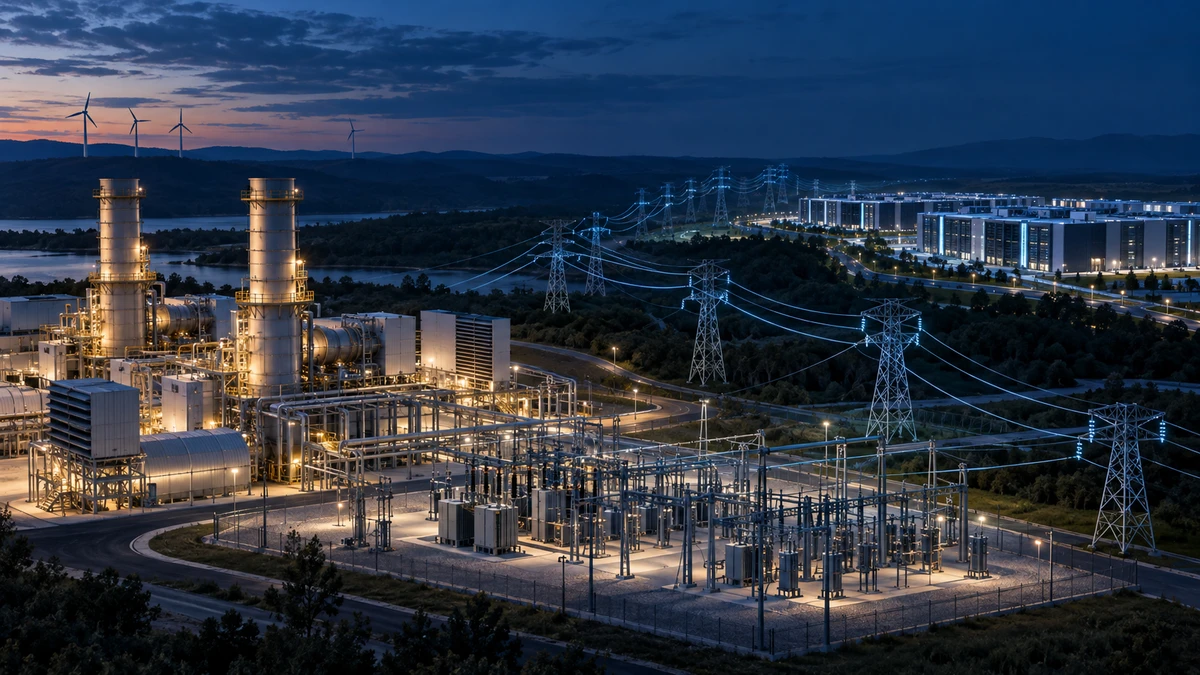
The AI boom started as a chip story. It is becoming an electricity story.
Data centers, advanced factories, electric vehicles, cooling systems, and grid upgrades all need more power—and they need it faster than utilities can currently connect it. That shifts the bottleneck from computing capacity to generation and transmission. GE Vernova sits directly in that gap. It sells the gas turbines that create dependable electricity, the transformers and grid systems that move it, and the long-term services that keep those assets operating.
That is why I’m bullish on GE Vernova stock. But I’m bullish, not blind. GEV is no longer a hidden industrial turnaround, and its valuation already assumes a lot of success. The case from here rests on one thing: converting a historic backlog into durable earnings faster than expectations rise.
Reader note: This article provides general educational and informational content, not individualized financial, investment, tax, legal, or trading advice. Facts and market conditions can change. Verify current information and consider qualified professionals for decisions specific to you.
Research checked through September 13, 2026. Market price is from the September 11 close.
The One-Sentence Thesis
GE Vernova may be the broadest picks-and-shovels beneficiary of the power supercycle because it sells equipment and services across generation, transmission, and grid modernization—not just one part of the electricity chain.
The macro setup is bigger than AI alone. The International Energy Agency expects global electricity demand to grow an average 3.6% annually from 2026 through 2030, with annual additions roughly 50% larger than during the prior decade. In the United States, the EIA expects record electricity sales in 2026 and 2027, driven in part by data centers and manufacturing. IEA | U.S. EIA
That demand has to pass through physical equipment. You cannot deploy a software update to create a turbine, a transformer, or a high-voltage direct-current system. These products require factories, specialized engineering, long lead times, and a service network. Scarcity is the point.
Here is the bull case in one screen:
| Thesis | The receipt | The risk | What to watch |
|---|---|---|---|
| Power demand is accelerating | $176 billion total backlog | Backlog is not revenue | Backlog conversion and delivery dates |
| Gas turbines are scarce | 116 GW of backlog plus slot reservations | 63 GW is reservations, not firm backlog | Reservation-to-order conversion |
| Grid equipment is the choke point | Electrification equipment backlog up 69% year over year, including Prolec | Capacity expansion can slip | Book-to-bill and segment margins |
| Earnings quality is improving | Power and Electrification Q2 margins of 18.8% and 18.4% | First-half cash flow was boosted by customer advances | Normalized cash conversion |
| AI is becoming an orders story | More than $5 billion of data-center orders year to date | Project timing can move | Repeat orders beyond hyperscaler headlines |
Financial figures are from GE Vernova’s second-quarter 2026 results and 10-Q. Backlog plus reservations should not be read as firm contracted revenue. Q2 results | Q2 10-Q
For the wider theme, see our breakdown of the AI data-center power boom and the power section in our eight AI trends shaping 2026.
Power: The Gas-Turbine Cycle Has Real Teeth
GE Vernova’s Power segment is the first engine of the thesis.
In the second quarter, Power booked $16.7 billion of orders and produced $5.5 billion of revenue. Adjusted EBITDA reached $1.0 billion, or an 18.8% margin. The company signed 20 GW of new gas contracts, converted 10 GW of prior reservations into orders, and shipped 3 GW during the quarter. Its gas-turbine equipment backlog increased to 53 GW, while another 63 GW sat in slot reservations. Management expects the combined figure to reach at least 125 GW by year-end 2026. GE Vernova Q2 2026 results
There are three reasons that matter.
First, utilities and data-center developers increasingly need firm power: electricity that is available when the sun is down, the wind is weak, or a facility cannot afford an interruption. Gas turbines can be deployed faster than new nuclear plants and can balance renewable-heavy grids. That does not make gas the only answer. It makes it one of the few scalable answers available on the timelines customers are demanding.
Second, supply is constrained. GE Vernova plans to raise annualized gas-equipment output capacity to 20 GW in the third quarter of 2026, 24 GW in 2028, and potentially 30 GW by 2030. When customers reserve manufacturing slots years in advance, the factory schedule itself becomes an asset. GE Vernova Q2 2026 results
Third, the sale is only the beginning. GE Vernova has roughly 7,000 installed gas turbines, and more than half of company backlog is services. Every new turbine can create years of parts, maintenance, upgrades, and contractual service revenue. That turns a cyclical equipment sale into a longer-duration customer relationship. GE Vernova investor overview
This installed base is the part of the thesis that headline investors can miss. AI may create the urgency, but service economics can create the durability.
Electrification: The Grid Is the Real Bottleneck
If Power creates electricity, Electrification gets it where it needs to go.
This segment includes transformers, switchgear, substations, high-voltage systems, grid automation, and related services. These are not glamorous products. They are also unavoidable. A data center with chips, cooling, and a signed power contract still cannot operate if it is waiting on a transformer or an interconnection.
The numbers show the squeeze. Q2 Electrification orders were $6.3 billion, about 1.7 times segment revenue. Revenue rose to $3.6 billion, and adjusted EBITDA margin expanded to 18.4% from 14.5% a year earlier. Equipment backlog reached $40.6 billion, up 69% year over year including the Prolec acquisition. GE Vernova Q2 filing
Prolec matters because transformers are one of the hardest grid constraints to solve quickly. GE Vernova valued the purchase of the remaining half of the business at $5.275 billion and completed it in February 2026. At announcement, Prolec was expected to produce about $3 billion of 2025 revenue at an adjusted EBITDA margin near 25%, with seven manufacturing sites and meaningful North American capacity. GE Vernova Prolec announcement
Then there is the AI order book. GE Vernova said data-center orders exceeded $5 billion in the first half of 2026—more than double the total for all of 2025. That is crucial because it moves the story from “AI could need power” to “customers are ordering equipment.” GE Vernova Q2 2026 results
Management has also described a potential $200 million to $300 million of electrical-equipment scope for a one-gigawatt data-center project. That is a management estimate, not guaranteed revenue, but it illustrates the content opportunity when GE Vernova supplies more of the system instead of one component. BofA Global Industrials Conference transcript
This is why I view GEV differently from a pure generator. A nuclear operator monetizes the electricity it owns. GE Vernova can sell the equipment needed across gas, renewables, nuclear-adjacent projects, and the grid itself. For the generation-side comparison, read our advanced-nuclear bull case.
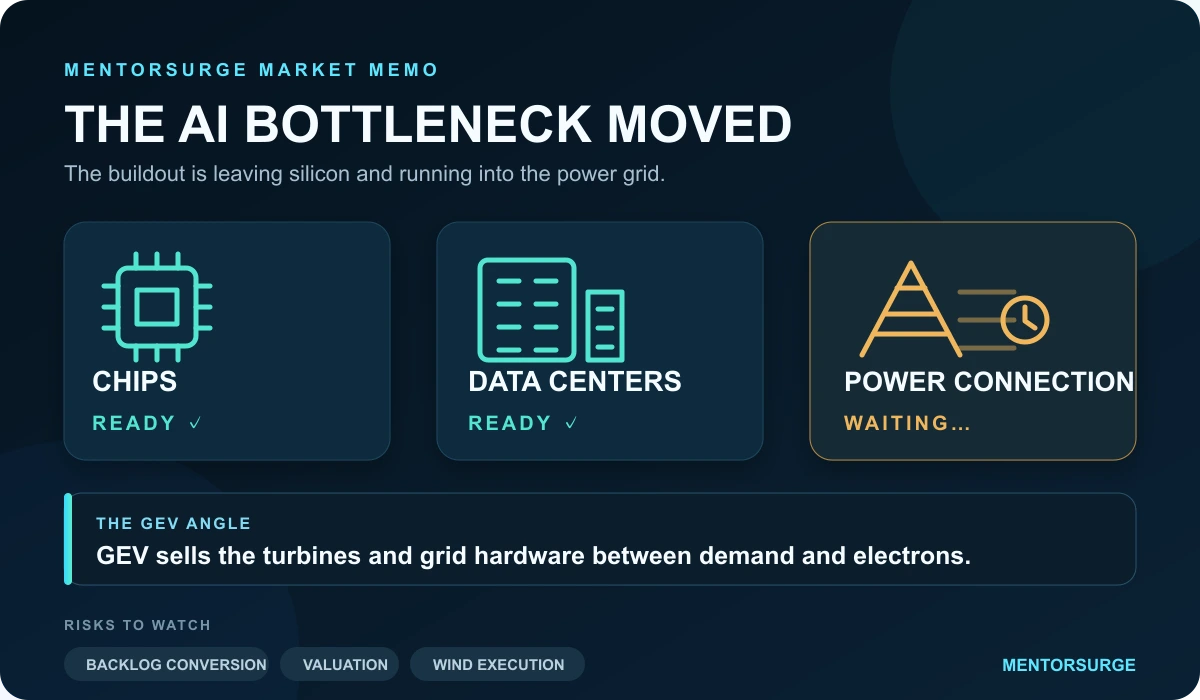
Original MentorSurge visual summary built specifically for this article.
The Receipts Are Strong—But the Stock Is Priced Like It
GE Vernova’s second quarter looked like an industrial company hitting an inflection point:
- Orders rose 88% organically to $24.2 billion.
- Revenue increased 12% organically to $11.1 billion.
- Adjusted EBITDA reached $1.2 billion, with margin expanding 340 basis points organically to 11.3%.
- Total backlog grew by $13 billion sequentially to $176 billion.
- Management raised 2026 revenue guidance to $45.5 billion–$46.5 billion.
- Free-cash-flow guidance jumped to $11.5 billion–$12.5 billion.
- Cash stood at $13.1 billion at quarter-end, and the company had returned about $3.9 billion to shareholders year to date.
Those are the receipts. They are also why GEV is not a cheap-stock thesis.
At the September 11 close of $957.27, the company was worth roughly $255 billion using the 266 million shares reported at June 30. Using $13.1 billion of cash, cash equivalents, and restricted cash against about $2.6 billion of debt produces rough net cash of $10.5 billion and enterprise value near $244 billion; unrestricted net cash would be slightly lower. At guidance midpoints, that is roughly 41 times enterprise value to implied 2026 adjusted EBITDA and 21 times equity value to guided free cash flow—a free-cash-flow yield below 5%. These are MentorSurge calculations using the latest filing, guidance, and market close; the share count and price will change. SEC 10-Q | Price history
Even the company’s Prolec-inclusive 2028 framework—about $56 billion of revenue at a 20% adjusted EBITDA margin—would equal roughly $11.2 billion of EBITDA. Using today’s rough enterprise value, that is still close to 22 times 2028 EBITDA before accounting for future cash accumulation. GE Vernova 2028 outlook
In plain English: the market already knows this is a special business.
There is one more accounting detail investors should respect. First-half free cash flow was excellent, but it was materially helped by working-capital inflows and customer down payments. Those advances are economically useful—they help fund production—but they arrive before GE Vernova delivers the related equipment and services. I would not treat every dollar as normal, repeatable owner earnings. The feed P/E is also less helpful than it looks because first-half GAAP profit included a $4.0 billion pre-tax remeasurement gain tied to Prolec. GE Vernova Q2 10-Q
That leaves Wind. Q2 Wind orders fell roughly 40%, revenue declined 10%, and segment adjusted EBITDA was negative $275 million. The segment lost $657 million in the first half, yet full-year guidance calls for a loss of roughly $400 million—so the second-half recovery embedded in guidance still has to be delivered. Wind is not the core reason to own the bull case today. It is turnaround optionality. If losses shrink, consolidated margins get another lift. If they do not, Power and Electrification must carry even more of the valuation. GE Vernova Q2 2026 results
What Would Make Me Wrong—and My Bottom Line
The cleanest bull cases have clear falsification tests. Here are mine:
- Reservations fail to become firm orders. The 63 GW of gas slot reservations are promising, but they are not the same as the 53 GW equipment backlog. Conversion is the proof.
- Backlog grows while delivery slips. A giant order book only creates value if factories expand, equipment ships, and margins hold. At guidance midpoints, the second half needs roughly $25.6 billion of revenue and $3.8 billion of adjusted EBITDA, versus $20.4 billion and $2.1 billion in the first half.
- Power or Electrification margins retreat below the mid-teens. The valuation requires profitable growth, not volume at any price.
- Customer advances reverse before earnings catch up. Cash-flow quality should normalize as backlog converts.
- Wind keeps consuming cash. The segment does not need to become the hero, but it cannot remain an unlimited drag.
- The multiple compresses faster than earnings grow. A great company can still produce a poor stock return when the starting price assumes perfection.
The next checkpoints are close. CEO Scott Strazik is scheduled to speak at the Morgan Stanley Laguna Conference on September 16, and third-quarter results are scheduled for October 28. I will be watching gas output capacity, reservation conversion, Electrification book-to-bill, data-center orders, Wind profitability, and the gap between reported and normalized cash flow. GE Vernova investor events
My bottom line is simple: GE Vernova is one of the highest-quality ways to invest in the physical buildout behind AI and electrification. Its advantage is breadth—generation equipment, grid hardware, and services—backed by a difficult-to-replicate installed base and a $176 billion backlog. I am bullish on the business because electricity demand is accelerating and GEV owns scarce manufacturing capacity where customers are waiting. I am more selective on the stock because the valuation leaves little room for ordinary execution. This is a long-cycle earnings-compounding thesis, not a cheap trade.
This article is educational and informational only. It is not a recommendation to buy, sell, short, or hold GE Vernova or any other security. Investing can result in loss of principal. Company guidance, market prices, and industry conditions can change; verify the latest quote and filings before making a decision.