
Most people do taxes backwards. They wait until April, stare at a number they hate, and then ask a tax preparer to perform financial magic on a year that already ended. That is like asking a barber to fix a haircut after the hair is already on the floor. Respectfully, the calendar won.
The viral version is simple: the IRS does not reward panic. It rewards planning, paperwork, and using the legal buckets Congress already gave you. Boring? Yes. Powerful? Also yes. The tax code is basically a video game where the hidden levels are called 401(k), HSA, Roth, basis, depreciation, and documentation.
This is the 2026 MentorSurge tax savings playbook. It is not a loophole circus, not fake write-offs, not somebody on social media explaining why your golden retriever is a business consultant. It is the practical stuff that can actually move your tax bill when done correctly.
Quick reality check before we get loud: this is education, not tax, legal, or financial advice. Tax rules are full of income limits, filing-status traps, phaseouts, state differences, and timing rules. Use this as a checklist for questions to ask a CPA or qualified tax professional, especially before changing retirement contributions, writing off business expenses, selling investments, or claiming new deductions.
The 2026 numbers that actually matter
For tax year 2026, the standard deduction rises to $32,200 for married couples filing jointly, $16,100 for single filers and married filing separately, and $24,150 for heads of household, according to the IRS 2026 tax inflation adjustments. That matters because the standard deduction is the first wall your taxable income runs into. Bigger wall, less taxable income.
The 401(k) employee deferral limit is $24,500 for 2026. If you are age 50 or older, the regular catch-up contribution is $8,000. If you are ages 60 through 63 and your plan allows it, the higher catch-up limit is $11,250, according to the IRS 401(k) contribution limits. Translation: payroll settings can be a tax lever, not just a retirement checkbox.
The MentorSurge Weekly
See the next move before it becomes obvious.
Get sharp market research and practical wealth ideas in one clear weekly email.
IRA contribution limits are also higher for 2026. The annual IRA limit is $7,500, with a $1,100 catch-up for people age 50 or older. Roth IRA contribution eligibility phases out at modified AGI of $153,000 to $168,000 for single filers and heads of household, and $242,000 to $252,000 for married couples filing jointly, according to the IRS 2026 retirement plan and IRA limits.
HSA limits for 2026 are $4,400 for self-only coverage and $8,750 for family coverage, with high-deductible health plan minimum deductibles of $1,700 self-only and $3,400 family, according to the IRS 2026 HSA limits. If you are eligible, the HSA is still one of the cleanest legal tax shelters normal people can access.
1. Max the employer match before trying to be clever
The first tax-saving move is also the least dramatic: contribute enough to your workplace retirement plan to get the full employer match if your employer offers one. A match is compensation. Skipping it because you forgot to log into payroll is not frugal. It is giving back part of your paycheck with extra steps.
Pre-tax 401(k) contributions can reduce current taxable income. Roth 401(k) contributions do not reduce current taxable income, but can create tax-free qualified withdrawals later. The choice depends on your current bracket, future bracket, cash-flow needs, and tax diversification. If you do not know which one to use, that is a perfect CPA or advisor conversation.
My default way to think about it: if you are young and in a lower bracket, Roth can be powerful because you are paying tax on the seed instead of the harvest. If you are in a high bracket now and expect a lower bracket later, pre-tax contributions may be attractive. The grown-up answer is not vibes. It is math.
2. Treat the HSA like the tax code accidentally gave you a cheat code
An HSA can be triple tax-advantaged when used correctly: deductible or pre-tax contributions, tax-deferred growth, and tax-free withdrawals for qualified medical expenses. That combination is rare. The catch is that you need to be HSA-eligible, usually through a qualifying high-deductible health plan.
If you already have an HSA and can afford to cash-flow smaller medical costs, one strategy is to save receipts, keep the HSA invested, and reimburse yourself later for qualified expenses. That requires clean records. Screenshotting a receipt into the void does not count as a system. Use a folder. Name the files. Future you is not Sherlock Holmes.
Newer IRS guidance tied to the One Big Beautiful Bill Act also made certain telehealth and remote-care HSA flexibility permanent for plan years beginning after December 31, 2024, and allows bronze and catastrophic marketplace plans to be treated as HSA-compatible high-deductible health plans starting in 2026 if the other rules are met. That does not mean every plan qualifies automatically. Read the plan documents.
3. Stop treating the IRA deadline like a rumor
IRAs are simple in concept and messy in details. Traditional IRA contributions may or may not be deductible depending on your income, filing status, and whether you or a spouse are covered by a workplace plan. Roth IRA contributions depend on income limits. Both can still be valuable, but the right answer changes by household.
For younger MentorSurge readers, the Roth IRA is usually the one people understand fastest: pay tax now, invest after-tax dollars, and potentially withdraw qualified money tax-free later. The flex is not that it feels exciting today. The flex is that decades of compounding can happen in a tax-free wrapper if you follow the rules.
High earners need extra caution. Direct Roth contributions phase out, and backdoor Roth strategies can run into pro-rata rules if you have pre-tax IRA money. That is CPA territory. Do not copy a finance influencer into a tax mess.
4. Use the SALT cap change without pretending it is unlimited
The state and local tax deduction got more interesting. The IRS state-and-local-tax topic says the SALT deduction limit is $40,000, or $20,000 for married filing separately, subject to a modified adjusted gross income limitation, and that the deduction will not be reduced below $10,000. See the IRS state and local tax deduction topic.
For high-tax states, property owners, and households with meaningful state income taxes, that can matter. But it only helps if you itemize and if your income does not phase it back down. This is where people get fooled by headlines. A bigger cap does not automatically mean a bigger refund for everyone. You need the full stack: filing status, income, property tax, state tax, mortgage interest, charitable giving, and whether itemizing beats the standard deduction.
5. Charitable giving: bunch it or document it
Charity can reduce taxes, but only if the giving is real, documented, and structured correctly. Starting in 2026, IRS Publication 505 says non-itemizers can deduct certain cash charitable contributions up to $1,000, or $2,000 for married couples filing jointly. Itemizers face a new 0.5% of AGI floor for charitable contributions beginning in 2026.
That changes the planning conversation. If you itemize, bunching multiple years of giving into one tax year or using a donor-advised fund may help some households clear the thresholds and maximize impact. But do not donate a dollar just to save a quarter. Charity should start with values. The tax benefit is the receipt, not the reason to become generous.
The unsexy win: keep acknowledgement letters, bank records, and donation receipts. If a deduction matters enough to claim, it matters enough to document.
6. Investors: harvest losses without washing them away
Tax-loss harvesting means selling an investment at a loss to offset capital gains, and potentially a limited amount of ordinary income if losses exceed gains. But the wash sale rule matters. IRS Publication 550 says a loss can be disallowed if you buy substantially identical securities within 30 days before or after the sale. See IRS wash sale rules in Publication 550.
This matters for investors and traders because emotional selling can accidentally become bad tax planning. If you sell a stock for a loss and buy the same or substantially identical exposure right back, the tax loss may not help you the way you think. Your broker may track some wash sales, but not every cross-account or spouse-account situation is effortless. Keep records and be careful.
The mature version: tax-loss harvest as part of portfolio design, not revenge trading with a deduction costume. Replace exposure thoughtfully, respect the window, and talk to a pro if you have options, crypto, multiple brokerages, or a spouse trading similar names.
7. Asset location: put the messy assets in the cleaner bucket
Asset allocation is what you own. Asset location is where you own it. Same portfolio, different tax drag. Interest-heavy assets, high-turnover funds, REITs, and certain income-producing holdings can be more tax-annoying in a regular brokerage account than in a retirement account. Broad index ETFs that throw off fewer taxable events can be friendlier in taxable accounts.
This is not flashy, which is why almost nobody posts about it. But tax drag compounds too. A portfolio that keeps 0.30% more per year because the pieces sit in smarter accounts can quietly outperform a sloppier portfolio with the same investments.
The meme version: stop buying the same thing everywhere because the app made it easy. Your account type is not decoration. It changes the after-tax result.
8. Business owners: deductions are not magic words
If you run a business, freelance, consult, sell online, trade under a real entity, or have a side hustle, the tax planning surface gets bigger. That can be good. It can also be where people do dumb things very confidently.
Real business expenses must be ordinary, necessary, and connected to the business. Home office deductions require regular and exclusive business use and can be calculated using the regular method or simplified option. The IRS simplified option is $5 per square foot up to 300 square feet, according to the IRS simplified home office deduction FAQ. The regular home office topic has more guardrails at IRS home office deduction topic.
Documentation is everything. Separate business bank account. Separate credit card if possible. Receipts. Mileage log. Invoices. Contracts. Calendar proof for meetings. A deduction without records is not strategy. It is a future headache wearing sunglasses.
For bigger purchases, bonus depreciation is back in a serious way. IRS guidance says 100% additional first-year depreciation applies to eligible depreciable property acquired after January 19, 2025, subject to the rules. See IRS bonus depreciation guidance. That can be powerful for legitimate business equipment, vehicles that actually qualify, and property that fits the business. It is not a reason to buy junk you would not otherwise buy.
9. Self-employed retirement plans can change the whole game
A freelancer who only uses a regular IRA may be leaving a lot of tax-advantaged space untouched. SEP IRAs, SIMPLE IRAs, and solo 401(k)-style arrangements can matter for self-employed people and small business owners. The right setup depends on employees, profit, cash flow, payroll, and admin tolerance.
For 2026, the SIMPLE IRA employee contribution limit is $17,000, with a $4,000 catch-up for people age 50 or older and a higher $5,250 catch-up for ages 60 through 63 if eligible. SEP employer contributions are generally limited to the lesser of 25% of compensation or $72,000 for 2026. Those limits come from IRS retirement-plan guidance, and the details matter.
Do not wait until the week taxes are due to ask about this. Plan setup deadlines and employer-contribution rules can matter. The best time to ask your CPA about self-employed retirement options is while there is still year left to operate.
10. The new OBBB deductions are real, but not for everyone
The One Big Beautiful Bill Act created temporary deductions for certain tips, overtime, car loan interest, and seniors for tax years 2025 through 2028. The IRS working-Americans-and-seniors page says the deductions have limits, phaseouts, and eligibility rules. Tips can be deductible up to $25,000. Qualified overtime can be deductible up to $12,500, or $25,000 for joint filers. Qualified passenger vehicle loan interest can be deductible up to $10,000. See IRS OBBB deductions for working Americans and seniors.
This is where headlines can get dangerous. These are not universal freebies. There are occupation rules, reporting rules, income phaseouts, vehicle requirements, loan timing rules, and filing requirements. If you earn tips, overtime, or bought a qualifying vehicle, this belongs on your CPA checklist. If you do not, it is just an interesting headline.
Seniors may also have a new deduction, but it is not the same as making Social Security tax-free for everyone. The detail matters. When politicians, influencers, and comment sections compress tax law into one sentence, assume something important got left out.
11. Clean vehicle credits: do not plan around expired candy
The IRS clean vehicle credit page says new, previously-owned, and commercial clean vehicle credits are not available for vehicles acquired after September 30, 2025. It also says the alternative fuel vehicle refueling property credit does not apply to property placed in service at a personal residence after June 30, 2026. See IRS clean vehicle credit update.
That means a 2026 tax plan should not casually assume an EV credit unless the timing and vehicle actually qualify. This is a perfect example of why tax planning has to be current. Last year's TikTok tax hack can become this year's expensive assumption.
12. Parents: credits are powerful, but records still win
Parents should look carefully at the child tax credit, dependent care credit, education-related benefits, 529 strategy, and employer dependent-care options. The most viral tax content usually skips the boring dependency rules, qualifying-child rules, provider information, and income phaseouts. That boring stuff is where the answer lives.
For dependent care, keep provider names, addresses, tax ID numbers when required, payment records, and dates. If you are paying for care so you can work or look for work, that belongs in the tax conversation. If the paperwork is scattered across texts, Venmo notes, and memory, fix the system now.
13. W-2 workers: your biggest lever is payroll, not vibes
If you are a W-2 employee with no business, no big portfolio, and no real estate, the biggest levers are usually payroll elections: 401(k), HSA or FSA if eligible, commuter benefits if offered, dependent-care benefits if applicable, withholding, and open-enrollment decisions.
That sounds basic because it is basic. But basic done early beats advanced done too late. If your employer offers benefits and you ignore the portal until open enrollment closes, you may have locked yourself out of some of the year's cleanest tax planning.
Check withholding too. A giant refund can feel fun, but it often means you gave the government an interest-free loan. Owing too much can trigger stress or penalties. The boring middle is intentional withholding that matches reality.
14. Traders and active investors: tax planning is part of risk management
If you trade actively, your tax situation can get messy fast. Short-term gains, options, wash sales, straddles, crypto reporting, multiple brokerages, and mark-to-market election questions can turn a simple portfolio into a tax project.
The practical rule: do not wait until tax season to export your data. Reconcile trades periodically. Save year-end statements. Know which accounts produced taxable activity. If you are serious about trading, tax records are part of the process, not office paperwork for later.
A trade is not done when you close the position. It is done when the records are clean enough that your future return is not chaos.
15. The December folder system
Here is the least glamorous but highest-return system in this entire post. Create a folder called 2026 Taxes. Inside it, create subfolders: W-2 and 1099, retirement, HSA and medical, charitable giving, property and mortgage, state taxes, business expenses, mileage, brokerage statements, crypto, dependents, education, and questions for CPA.
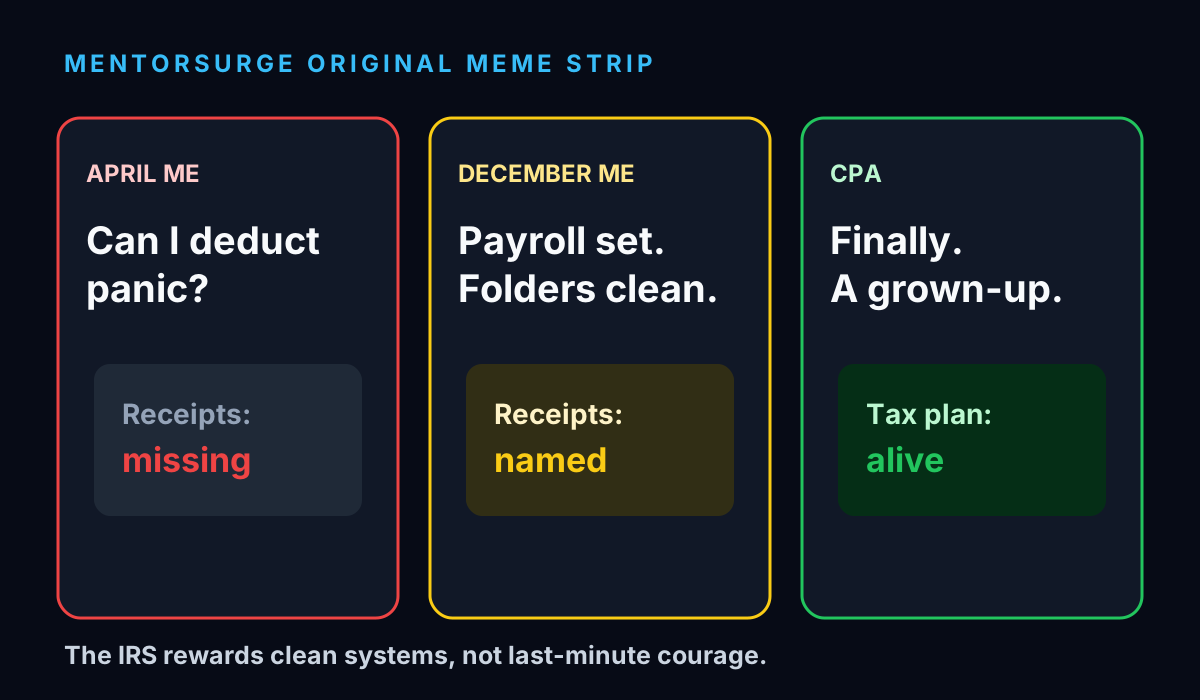
Every time something tax-relevant appears, put it there. Not later. Now. The reason this works is ADHD-proof simplicity: one folder, obvious names, no treasure hunt. Your CPA does not need a cinematic backstory. They need clean evidence.
Add a living note called CPA Questions. Every time you wonder, can I deduct this, write it down. That is how you stop relying on memory in April. Memory is where deductions go to die.
The MentorSurge tax savings order of operations
- First: build an emergency buffer so taxes do not force credit-card debt.
- Second: capture the full employer match if available.
- Third: use HSA, FSA, dependent-care, and workplace benefits if eligible.
- Fourth: decide Roth versus pre-tax retirement contributions with bracket math, not internet slogans.
- Fifth: review itemizing, SALT, mortgage interest, and charitable-giving strategy before year-end.
- Sixth: harvest investment losses only if it fits the portfolio and avoids wash-sale problems.
- Seventh: for business owners, separate accounts and document every real business expense.
- Eighth: ask about self-employed retirement plans, depreciation, and entity structure early.
- Ninth: adjust withholding and estimates so cash flow does not ambush you.
- Tenth: keep the folder clean all year.
What not to do
Do not fake business expenses. Do not buy something you do not need because it is deductible. Do not claim a home office that is also your guest room, gaming room, storage room, and folding-laundry room. Do not invent charitable values. Do not ignore wash-sale rules. Do not assume a headline deduction applies to you. Do not trust anyone who makes tax planning sound like a cheat code with no paperwork.
The best tax savings are boring on purpose. Retirement contributions. Health savings. Legal deductions. Timing. Records. Professional review. If someone makes it sound rebellious, there is a decent chance the IRS already has a PDF about it.
Bottom line
Tax savings are not about beating the IRS in a street fight. They are about arranging your financial life so the legal rules work for you instead of against you. That means moving money before deadlines, using the right accounts, documenting what happened, and asking better questions before the year closes.
The people who win are not always the highest earners. They are the ones who stop treating taxes like an April surprise party. Build the folder. Check the benefits portal. Know the limits. Ask the CPA early. Then let everyone else panic-search deductions while you are already done.
Reader checklist
A practical checklist for The 2026 Tax Savings Playbook Legal Ways to Pay
Break down The 2026 Tax Savings Playbook Legal Ways to Pay with evidence first around salt deduction, before opinion hardens into bias. A practical 2026 tax-savings checklist for W-2 workers, investors, freelancers, parents, and business owners, built from current IRS limits and rules.
For this wealth piece, slow the claim, filter the habit, and document the cost of doing nothing. Connect that work back to "4. Use the SALT cap change without pretending it is unlimited" and "6. Investors: harvest losses without washing them away" so the idea turns into a specific next move.
The win is turning one sharp idea into one action you can repeat this week. Keep personal finance and 2026 taxes visible while you decide, because vague motivation fades faster than a written rule.