
The Fed Held Rates. Here Is What It Means for Your Credit Card, Savings and Car Loan
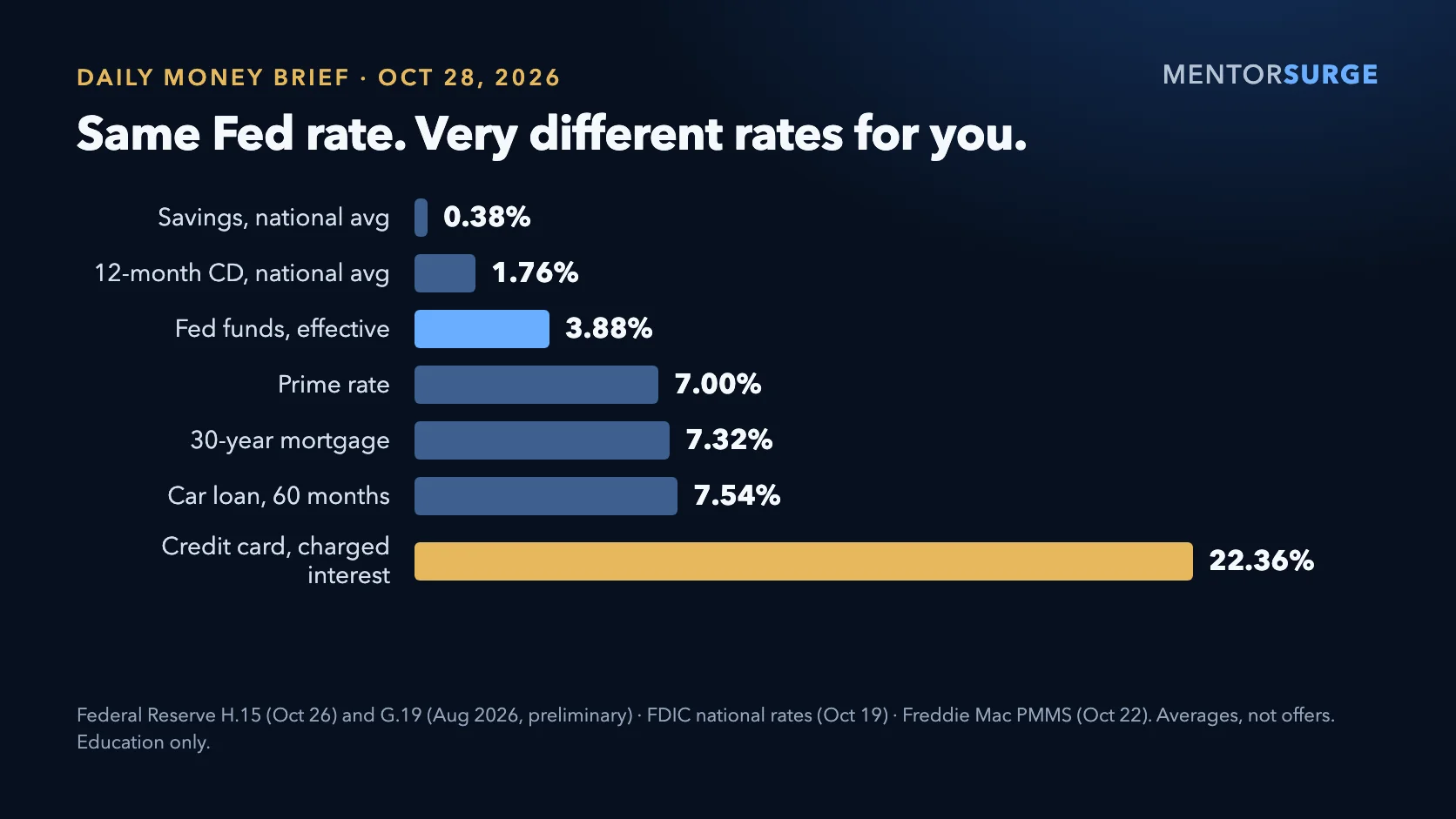
The Fed left rates alone today. The average card that charges interest still costs nearly six times what banks charge each other, and the average savings account pays about a tenth of it.

Fed decision released October 28, 2026 at 2:00 p.m. ET. Other figures were checked October 28 and carry their own dates below.
The number
On Wednesday, October 28, the Federal Reserve kept the target range for the federal funds rate at 3.75% to 4.00%. That is the level it set on September 16 with a quarter-point increase. Read the October 28 statement.
The vote was 10 to 2. Two officials, Lisa Cook and Beth Hammack, wanted another quarter-point increase.
The federal funds rate is what banks charge each other overnight. You never pay it directly. You pay the rates stacked on top of it.
Where your money feels it
| Rate | Average | Source and date |
|---|---|---|
| Federal funds, effective | 3.88% | Federal Reserve H.15, Oct 26, 2026 |
| Prime rate, the index many variable-rate cards follow | 7.00% | Federal Reserve H.15, Oct 26, 2026 |
| Credit cards, accounts charged interest | 22.36% | Federal Reserve G.19, Aug 2026, preliminary |
| New car loan, 60 months, at banks | 7.54% | Federal Reserve G.19, Aug 2026, preliminary |
| 30-year fixed mortgage | 7.32% | Freddie Mac PMMS, week of Oct 22, 2026 |
| Savings account, national average | 0.38% | FDIC national rates, Oct 19, 2026 |
| 12-month CD, national average | 1.76% | FDIC national rates, Oct 19, 2026 |
Sources: Federal Reserve H.15 and G.19, FDIC national rates, and Freddie Mac's mortgage survey. These are averages, not offers.
What a hold means for you
Credit cards. A hold means no automatic change to a variable card rate this month, and no relief either. Many variable-rate cards follow the prime rate, which was 7.00% on October 26. At the average 22.36%, a $3,000 balance costs about $56 a month in interest ($3,000 × 22.36% ÷ 12 = $55.90). The meeting did not change that math.
Savings. Banks set their own savings rates, and the average has not kept up. The national average savings rate is 0.38%, which earns about $19 a year on $5,000. The rate banks charge each other overnight is 3.88%. If your account pays close to the average, compare what other FDIC-insured banks pay before assuming yours is normal.
Car loans and mortgages. A fixed-rate loan you already have does not change. If you are shopping, fixed rates follow longer-term bond yields more closely than the Fed's overnight rate. The 10-year Treasury yield was 5.00% on October 26, and the average 30-year mortgage was 7.32% the week of October 22.
One thing to do this week
- Open your latest card statement or app and find the purchase APR. Note whether it says variable.
- Multiply your balance by the APR, then divide by 12. That is roughly what carrying the balance costs you each month.
- Write that number down and compare it next month.
Your balance drives the cost far more than any single Fed meeting. On a $3,000 balance at 22.36%, a quarter-point change in the APR moves the monthly interest by about 63 cents. Paying the balance down by $1,000 lowers it by about $18.63 a month.
Go deeper
- What Credit Card Interest Really Costs: estimate your interest and see how a bigger payment changes the payoff.
- Interest Rates: From the Fed's Decision to Your Budget: list which of your own rates can move.
- Market dashboard: watch the rate-sensitive bond funds in the Volatility + Rates group.
What comes next
The Fed's next scheduled meeting is December 8–9, 2026, and it will include updated economic projections (Fed meeting calendar). Nobody knows that outcome, and this brief makes no forecast. What you can control before then is the number from your statement.
Your next step: Work through the credit card lesson with your own statement open. It takes about 14 minutes.
Educational commentary only, not individualized investment, tax, or legal advice. Rates shown are published averages, not offers, and your own rates may differ. Examples are illustrations. Economic data may be revised.