
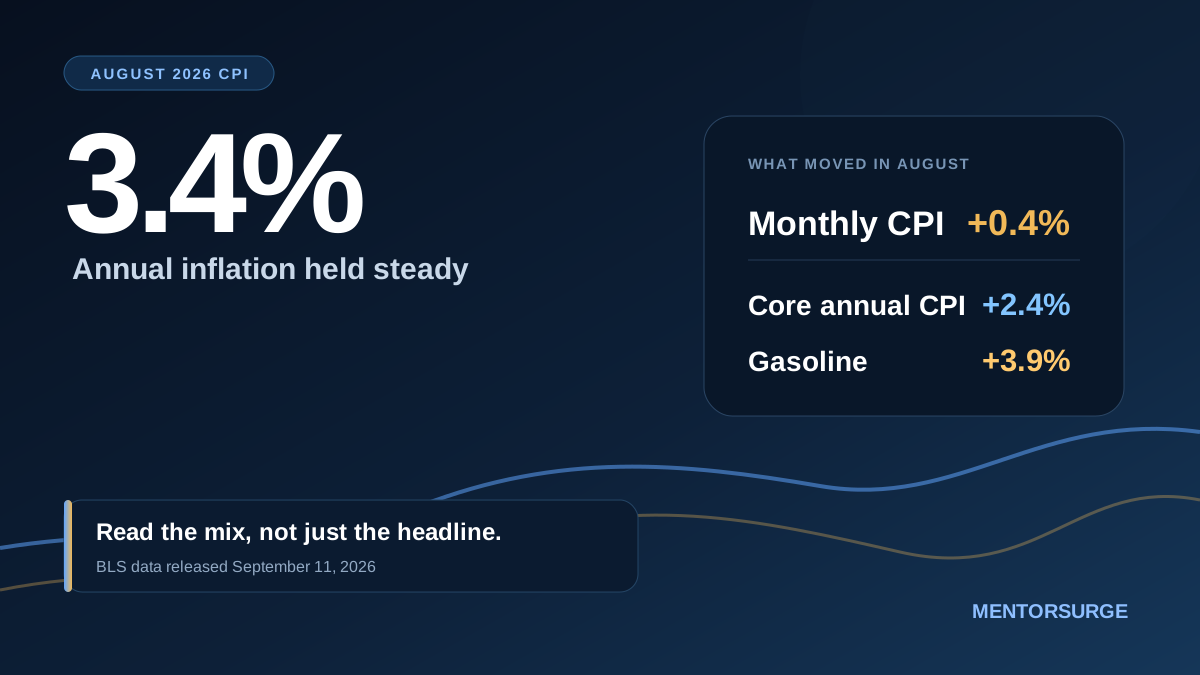
Inflation did not get worse over the last year in August. It did not get better either.
The Consumer Price Index rose 0.4% during the month and 3.4% over the prior 12 months, according to the Bureau of Labor Statistics. That annual number matched July. The part that deserves attention is the monthly move. Gasoline rose 3.9% and accounted for more than one third of the increase.
That is the headline. The useful question is what it means when you are trying to build wealth from zero.
It does not mean every price rose 3.4%. It does not tell you what the Federal Reserve will do at its September 15 and 16 meeting. It definitely does not produce a clean signal to buy or sell anything.
It does tell you that the pressure on everyday budgets is still real, the path back toward stable inflation is uneven, and the order of your financial priorities matters more than a prediction about one meeting.
Data in this article was checked on September 12, 2026.
What the August 2026 inflation rate actually means
The CPI tracks the change in prices paid by urban consumers for a broad basket of goods and services. The 3.4% annual reading means that the measured basket cost 3.4% more than it did one year earlier.
Imagine a simplified basket that cost $100 one year ago. A 3.4% increase would move it to $103.40. That example is not your personal budget. It is simply the math behind the rate.
The monthly reading tells a different part of the story. Prices rose 0.4% from July to August after seasonal adjustment. A single month is noisy, so it should not be treated as a new long term trend by itself. Still, 0.4% is faster than July's 0.1% monthly increase.
The details matter:
- Gasoline rose 3.9% in August.
- The broader energy index rose 2.1%.
- Shelter rose 0.3%.
- Food rose 0.1%.
- Prices excluding food and energy rose 0.3% for the month and 2.4% over the year.
That last measure is often called core inflation. It removes food and energy because those categories can move sharply from month to month. Core inflation slowed on a yearly basis from 2.5% in July to 2.4% in August, while headline inflation stayed at 3.4%.
Both things are true. The underlying annual trend showed some improvement, and the latest monthly headline reading moved faster because energy jumped.
That is why one number rarely tells the whole story.
Your personal inflation rate is probably different
The national CPI is an average. Your budget is not.
Someone who drives 70 miles a day can feel a gasoline increase immediately. Someone who works from home may barely notice it. A renter facing a lease renewal has a different experience from a homeowner with a fixed mortgage payment. A parent buying groceries for four people has a different basket from a student sharing an apartment.
This is where financial headlines can become frustrating. A report may say inflation is unchanged, while your checking account says life became more expensive.
The disagreement can be completely real because the weights are different.
I think the useful move is to separate the national signal from the household signal. The national report helps explain the economy. Your own spending history explains your pressure points.
A simple review can answer three better questions:
- Which three categories took the most dollars last month?
- Which one changed the most over the last three months?
- Which cost is fixed, and which one can realistically move?
That creates a personal inflation map. It is more useful than arguing with an average.
If gasoline is the problem, the answer may be route planning, carpooling, or grouping errands. If food away from home is the problem, the answer may be a weekly meal plan. If rent dominates the budget, the decision is larger and slower. It may involve a roommate, a move, or a longer income plan.
None of those choices is easy. The point is that a specific pressure deserves a specific response.
Gasoline changed the headline, not the entire economy
Gasoline was the loudest part of the August report. Its 3.9% monthly increase accounted for more than one third of the overall CPI rise. The gasoline index was also 27.4% higher than a year earlier.
That can spill into more than the price at the pump. Transportation is an input for businesses, workers, deliveries, and services. Higher fuel costs can squeeze household cash flow directly and raise operating costs elsewhere.
But it would be a mistake to turn one volatile category into a complete economic story.
Food at home was unchanged during August. Medical care fell 0.2%. Motor vehicle insurance fell 0.8%. Shelter continued to rise, but its 0.3% monthly increase was not the same kind of shock as gasoline.
This mix matters because it changes how I read the report. Inflation pressure was broad enough to remain a problem, but the monthly acceleration was not evenly distributed across the basket.
The practical lesson is not to panic at the headline or dismiss it. It is to look underneath it.
What the Federal Reserve can affect
The Federal Reserve held the federal funds target range at 3.5% to 3.75% on July 29. Three voting members preferred a quarter point increase. The next scheduled meeting is September 15 and 16, and it includes an updated Summary of Economic Projections.
That setup guarantees attention. It does not guarantee the decision.
The Fed uses monetary policy to influence financial conditions across the economy. Changes in its policy rate can affect other interest rates, credit demand, asset prices, and spending. Those effects are indirect, and they work with delays.
The Fed does not set your credit card rate, mortgage rate, savings yield, rent, grocery bill, or gasoline price. Markets and financial institutions make many of those decisions using funding costs, risk, competition, expected inflation, and other inputs.
This distinction matters because people often expect an immediate one for one change. A quarter point move by the Fed does not mean every consumer rate moves by the same amount on the same day.
It also means that building a financial plan around a single rate prediction is fragile.
If the Fed holds, your high interest balance is still expensive. If the Fed raises, an emergency expense is still an emergency. If the Fed cuts at a future meeting, a weak budget does not automatically repair itself.
The meeting matters for the economy. Your system matters every month.
The order I use when money feels tight
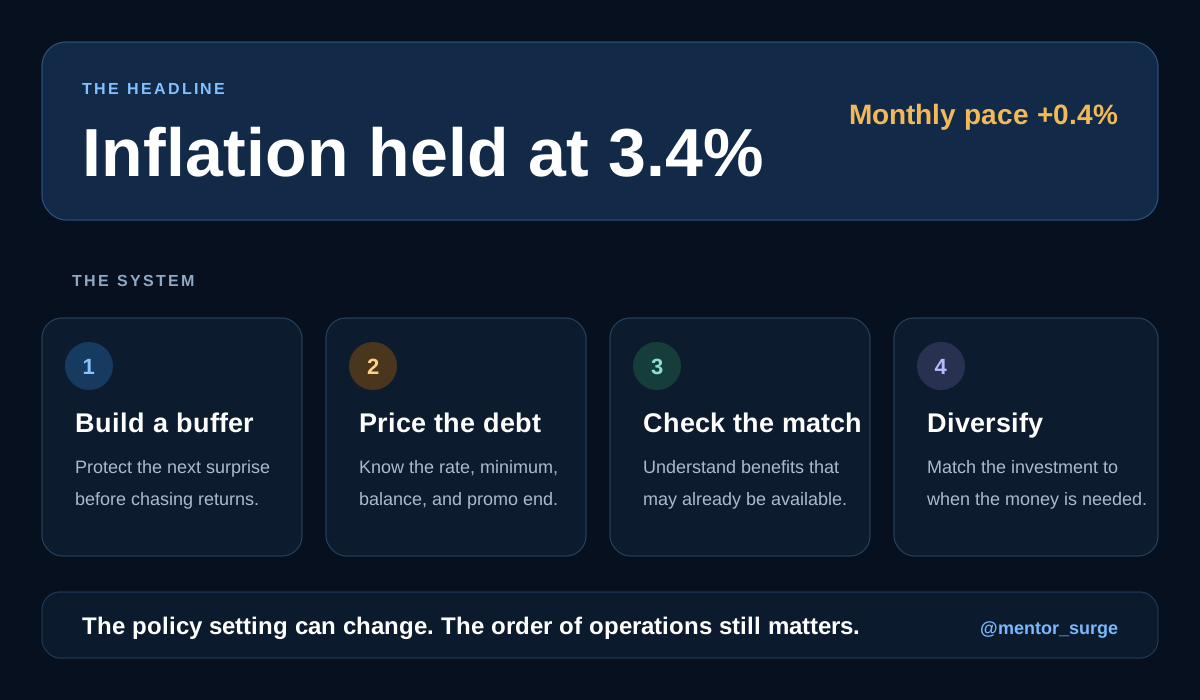
When prices are moving and the Fed is about to meet, the temptation is to do something dramatic. I think the better starting point is an order of operations.
This is not individualized advice. It is the framework I use to keep urgent headlines from rearranging basic priorities.
1. Protect the next surprise
The Consumer Financial Protection Bureau describes an emergency fund as one of the first steps toward protecting yourself from unplanned expenses. It also notes that even a small amount can provide some financial security.
That matters because the first job of cash is not maximum return. It is preventing a normal surprise from becoming expensive debt.
For someone starting from zero, the first milestone can be deliberately modest. It might be enough to cover a car repair, an insurance deductible, or one week of essential bills. The right number depends on the household, job stability, insurance, transportation, and support network.
Where the money sits matters too. The FDIC generally insures deposits up to $250,000 per depositor, per insured bank, per ownership category. That protection applies to eligible deposit accounts at insured banks, not to stocks, bonds, mutual funds, or crypto assets.
The tradeoff is simple. Emergency cash may not grow like a long term investment, but it has a different job.
2. Measure the cost of high interest debt
Investor.gov warns that few investments are likely to match the cost of high interest credit card debt with less risk. That is a useful reality check when social media makes investing look urgent.
A card charging a high annual rate creates a known cost. An investment return is uncertain.
This does not mean every person has the same payoff order. Employer matches, minimum payments, promotional rates, taxes, and liquidity all change the details. It does mean the interest rate belongs in the decision, not in the fine print.
I would rather know four facts than guess:
- The balance on each account
- The annual interest rate
- The required minimum payment
- The date any promotional rate ends
Those four facts turn anxiety into a map.
3. Capture the benefits already available
The tax code gives retirement accounts meaningful space in 2026. The IRS says the employee contribution limit for 401(k), 403(b), governmental 457 plans, and the federal Thrift Savings Plan is $24,500. The IRA contribution limit is $7,500.
Those are legal maximums, not targets for every budget. Someone building from zero may be nowhere near them, and that is normal.
The more immediate question is whether an employer offers a match and what is required to receive it. A match can materially change the math, but plan rules vary. The plan document and benefits team are the right sources for the exact terms.
The goal is not to chase a large annual limit. It is to understand what is already on the table.
4. Keep long term investing broad enough to survive being wrong
Investor.gov frames asset allocation around time horizon and risk tolerance. It also explains that diversification spreads money among different investments to reduce concentration risk.
That is less exciting than guessing the next Fed move. It is also more durable.
The longer the time horizon, the more room there may be to tolerate price swings. A near term goal has less room for that volatility. Money needed for rent, tuition, a car, taxes, or an emergency has a different job from money intended for decades in the future.
The question is not only what could rise. It is when the money will be needed and what happens if the market is down at that moment.
This is where allocation beats prediction. A diversified plan can admit uncertainty. A concentrated bet often requires certainty that nobody actually has.
What to watch after the September meeting
The September 16 policy statement will matter, but the decision itself will not be the only useful information.
I will be watching five things:
- The new target range
- The vote and any dissents
- The updated economic projections
- The inflation language in the statement
- The chair's explanation of what evidence could change the path
The words matter because policy is a sequence, not a single event. One meeting can change the rate. The explanation can change expectations for several meetings.
There is also a timing problem. The August CPI report is fresh, but the Fed will combine it with employment data, financial conditions, inflation expectations, and other evidence. Policymakers can interpret the same report differently because they are weighing risks on both sides of the mandate.
That is another reason not to build a personal plan around a precise forecast.
After the meeting, I would update the facts, not rewrite the entire financial system. The emergency fund still has a job. High interest debt still has a cost. A retirement match still has rules. A diversified long term allocation still depends on time horizon and risk.
The policy setting changes. The order of operations remains recognizable.
The honest read
August inflation was not a clean victory and it was not a collapse.
The annual CPI rate stayed at 3.4%. Core inflation eased to 2.4% over the year. Gasoline drove much of the faster monthly headline. Shelter continued to rise. Food was comparatively quiet.
Both things are true. Some underlying measures moved in a better direction, and many households still feel squeezed by the categories that matter most to them.
The most useful response is not a prediction about the next headline. It is knowing where your own pressure is, keeping the next surprise from becoming expensive debt, understanding the cost of every balance, using the benefits available to you, and matching long term investments to the time when the money will actually be needed.
That is not flashy. It is how a financial system becomes harder to break.
Sources and research note
Data was checked on September 12, 2026. Economic releases and policy settings can change after publication.
- Bureau of Labor Statistics, August 2026 CPI release
- Federal Reserve, July 29, 2026 FOMC statement
- Federal Reserve, FOMC meeting calendar
- Federal Reserve, how monetary policy works
- Consumer Financial Protection Bureau, emergency fund guide
- Federal Deposit Insurance Corporation, deposit insurance
- Investor.gov, high interest debt
- Investor.gov, asset allocation and diversification
- Internal Revenue Service, 2026 retirement contribution limits
MentorSurge provides general educational and informational content. It is not a registered investment adviser, broker, tax professional, or financial planner. Nothing here is individualized financial, investment, tax, legal, or trading advice. Verify facts, do your own research, and consult qualified professionals for decisions that affect you.